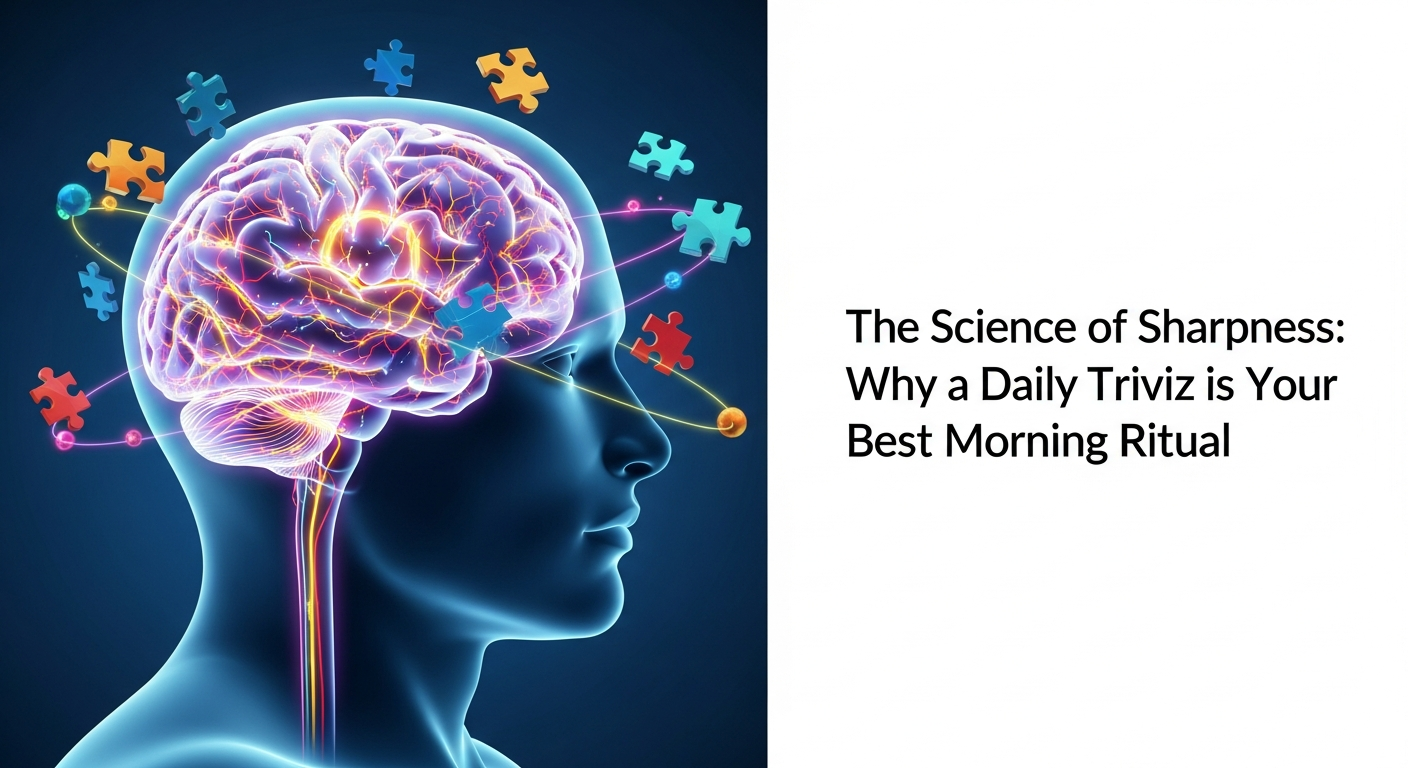
#The Science of Sharpness: Why a Daily Trivia Quiz is Your Best Morning Ritual
Picture this: your alarm goes off, and before your feet even touch the floor, your hand instinctively reaches for your smartphone. For most of us, the next fifteen minutes are a blur of "doom-scrolling"—an aimless trek through stressful news headlines, filtered social media feeds, and work emails that haven't even been processed yet. This passive consumption doesn't just waste time; it sets a reactive tone for the rest of your day, leaving your brain in a state of low-level anxiety before you've even had your first cup of coffee.
There is, however, a growing movement toward the "digital morning ritual," a deliberate shift from passive scrolling to active mental engagement. Enter the daily trivia quiz. Far more than just a momentary distraction, a structured morning quiz acts as a cognitive ignition switch. By swapping out the chaos of the newsfeed for a curated general knowledge challenge, you transition your brain from a state of idle reception to active problem-solving. This simple micro-habit is the secret weapon of high-performers who want to start their day with a sense of accomplishment and mental clarity.
In this article, we will explore the neurological and psychological reasons why a quiz of the day is the ultimate productivity tool. We’ll dive into how these short bursts of information can rewire your brain for better focus, improve your long-term memory, and provide a sustainable "brain gym" experience that fits perfectly into even the busiest schedules.
Key Takeaway: Replacing passive social media consumption with a daily trivia quiz shifts the brain from a reactive state to a proactive, problem-solving mindset.
#The Psychology of Curiosity: Why Our Brains Crave a "Quiz of the Day"
Why is it so satisfying to know the capital of a remote country or the name of a 1950s jazz musician? The answer lies in the "Information Gap Theory" of curiosity. When we are presented with a question we don't know the answer to, it creates a mental itch—a state of deprivation that our brains are hardwired to resolve. The quiz of the day leverages this natural drive, turning the act of learning into a rewarding game. When you finally land on the correct answer, your brain's reward system releases a surge of dopamine, the "feel-good" neurotransmitter associated with pleasure and motivation.
This dopamine hit serves a dual purpose. First, it provides an immediate mood boost, which is essential for shaking off morning grogginess. Second, it reinforces the habit of seeking out new information. Unlike the empty calories of social media likes, the satisfaction of a daily trivia quiz is tied to competence and mastery. You aren't just consuming; you are succeeding. This builds "self-efficacy," the belief in your own ability to solve problems and recall information under pressure.
Furthermore, the variety inherent in today's trivia questions keeps the brain on its toes. One moment you are calculating a math problem, and the next you are recalling a historical date or a pop culture fact. This rapid switching between different domains of knowledge prevents mental "autopilot" and forces the prefrontal cortex to engage fully. It’s the difference between a slow walk on a treadmill and a high-intensity interval training (HIIT) session for your mind.
Key Takeaway: Trivia triggers the brain's reward system through the resolution of curiosity, providing a dopamine-driven "win" that builds confidence and mental alertness early in the day.
#The 10-Question Sweet Spot: Why 10 Question Trivia Daily is the Perfect Length
One of the biggest hurdles to starting a new habit is the perceived time commitment. This is where 10 question trivia daily shines as a "micro-habit." In the world of behavioral science, micro-habits are small, low-stakes actions that are easy to repeat until they become automatic. A ten-question set usually takes between three and five minutes to complete—roughly the time it takes for your coffee to brew. This brevity is intentional; it’s long enough to provide a genuine general knowledge challenge, but short enough that you can never claim you’re "too busy" to do it.
The "sweet spot" of ten questions also aligns with our working memory capacity. When a quiz is too long, mental fatigue sets in, and the activity starts to feel like work. When it’s just ten questions, the brain remains in a state of "flow"—that elusive zone where you are fully immersed and focused. This makes daily mental stimulation sustainable over months and years, rather than just a few days of intense effort followed by burnout.
Consistency is the most important factor in cognitive health. By committing to a 10 question trivia daily routine, you are leveraging the power of compound interest. Five minutes a day adds up to over 30 hours of active learning per year. Because these questions are diverse, you are effectively building a broad "mental map" of the world, one tiny piece at a time. It turns the daunting task of "lifelong learning" into a series of manageable, bite-sized victories.
Key Takeaway: The 10-question format is the ideal length for habit formation, providing enough challenge to engage the brain without becoming a time-consuming chore.
#Anatomy of a Great Daily Quiz App: Features That Drive Engagement
Not all trivia experiences are created equal. The rise of the daily quiz app has transformed a once-static hobby into a dynamic, gamified experience. A high-quality app does more than just display questions; it uses psychological triggers to keep you coming back. The most effective feature is the "streak." There is a profound psychological resistance to "breaking the chain." When you see that you’ve completed your daily trivia quiz for 45 days in a row, the desire to maintain that number becomes a powerful motivator to log in on day 46.
Another critical component is the leaderboard or social comparison feature. Humans are social creatures, and we are naturally inclined to see how we stack up against our peers. Whether it’s a global ranking or a private group with friends, the competitive element of a daily quiz app adds a layer of accountability. It transforms a solitary activity into a shared experience, sparking conversations and healthy rivalries that extend beyond the screen.
Finally, variety and feedback are essential. The best brain training apps categorize their questions (Science, History, Geography, Arts) and provide instant feedback. If you get a question wrong, the app shouldn't just move on; it should provide the correct answer and perhaps a brief fun fact. This "corrective feedback loop" is where the actual learning happens. It ensures that today's trivia questions don't just test what you know, but actually expand your knowledge base for tomorrow.
Key Takeaway: Effective quiz apps use streaks, leaderboards, and immediate feedback to turn learning into a compelling, social, and habit-forming game.
#Beyond Facts: How Today's Trivia Questions Improve Neuroplasticity
A common misconception is that trivia is just about "useless facts." In reality, the process of answering today's trivia questions is a sophisticated workout for your brain's architecture. Every time you try to recall a piece of information, you are engaging in "retrieval practice." This process strengthens the synaptic pathways between neurons. Think of your memory like a forest: the more times you walk a specific path to find a piece of information, the clearer and more permanent that path becomes. This is the essence of neuroplasticity—the brain's ability to reorganize itself by forming new neural connections.
Engaging in a general knowledge challenge also improves "fluid intelligence"—the ability to reason, analyze, and solve problems in unique ways. Trivia often requires you to use deductive reasoning. If you don't know the exact answer, your brain starts connecting related dots: "I know this author lived in the 19th century, and I know this book was written during the Civil War, so the answer must be..." This cross-lateral thinking is vital for maintaining a sharp, adaptable mind in our professional lives.
Moreover, daily mental stimulation through trivia helps combat the "use it or lose it" principle of cognitive aging. By constantly challenging yourself with new topics, you are forcing your brain to stay flexible. This doesn't just help you remember who won the Oscar in 1994; it improves your overall "processing speed," making you quicker in meetings, more articulate in conversations, and more efficient at learning new skills at work.
Key Takeaway: Trivia is a form of retrieval practice that strengthens neural pathways, enhances deductive reasoning, and maintains overall cognitive processing speed.
#Social Trivia: Building Community and Office Camaraderie
While the daily trivia quiz is an excellent solo ritual, its power is multiplied when shared. In the modern workplace—especially in remote or hybrid environments—finding ways to connect outside of "task-based" communication is a challenge. Many teams are now using today's trivia questions as a digital watercooler. Sharing your daily score in a Slack channel or a group chat creates a low-pressure way to interact, laugh at mistakes, and celebrate "the genius of the day."
This social layer of trivia builds "psychological safety" within teams. When a manager misses a question and laughs about it, it humanizes them and fosters a culture where it's okay not to know everything. Conversely, when a junior employee nails a difficult 10 question trivia daily set, it gives them a moment to shine. It’s a form of "micro-bonding" that builds the social fabric of a community one question at a time.
Beyond the office, trivia is a powerful tool for staying connected with family and friends across distances. A daily quiz app that allows for "friend challenges" can bridge the gap between generations. It’s a rare activity that a teenager and a grandparent can enjoy equally, providing a common ground that transcends age and geography. In an era of increasing digital isolation, these small points of contact are vital for our emotional well-being.
Key Takeaway: Shared trivia experiences foster social bonding, improve workplace culture, and provide a meaningful way to stay connected with friends and family.
#The Long-Term ROI: Cognitive Reserve and Preventing Stagnation
The most profound benefits of a daily trivia quiz are those that accumulate over decades. Neurologists often speak about "cognitive reserve"—the brain's resilience to neuropathological damage. Think of it as a structural buffer. The more you challenge your brain throughout your life with micro-learning habits, the more "back-up" connections your brain builds. Research suggests that individuals with higher cognitive reserve can delay the onset of symptoms related to dementia and Alzheimer’s because their brains find "workarounds" for damaged areas.
Consistent daily mental stimulation prevents the mental stagnation that often comes with routine-heavy adult lives. As we get older, we tend to stick to what we know, which leads to cognitive "atrophy." Trivia forces us out of our comfort zones. It introduces us to names, places, and concepts we would never encounter in our daily chores or specific professional niches. This keeps our curiosity alive, which is a key indicator of long-term mental health and life satisfaction.
Investing five minutes a day in a quiz of the day is, quite literally, an insurance policy for your mind. The "Return on Investment" (ROI) isn't just about being the smartest person at the next dinner party; it’s about maintaining your independence, your wit, and your ability to engage with the world well into your later years. It is perhaps the most cost-effective cognitive health benefit available to us in the digital age.
Key Takeaway: Regular trivia play builds cognitive reserve, which acts as a protective buffer against age-related mental decline and helps maintain lifelong curiosity.
#Conclusion: Start Your Daily Trivia Streak Today
The transition from a morning of "doom-scrolling" to a morning of "brain-growing" is one of the simplest yet most effective upgrades you can make to your life. By integrating a daily trivia quiz into your routine, you are choosing active engagement over passive consumption. You are giving your brain the dopamine-rich start it craves, building a sustainable micro-learning habit, and investing in your long-term cognitive health.
The beauty of the 10 question trivia daily format is that it requires no special equipment, no significant time commitment, and no prior expertise. All it requires is a few minutes of your time and a willingness to be curious. Whether you use a dedicated daily quiz app or join a community of trivia lovers online, the goal is the same: to keep your mind sharp, your spirit curious, and your mornings productive.
Are you ready to see how you stack up? Don't let another morning slip away into the void of the social media feed. Find your favorite platform, challenge a friend, and start your streak today. Your brain—both now and thirty years from now—will thank you for it. The quest for knowledge is a marathon, not a sprint, and every today's trivia questions set is a step toward a sharper, more vibrant you.
Read next
See all →
Unlock Your Brain's Potential: The Power of Cognitive Games for Adults
Explore the transformative power of cognitive games designed for adults. Learn how engaging in these brain-training activities can enhance your memory, sharpen your focus, and boost overall mental agility, helping you unlock your brain's true potential.
Beyond Sudoku: The Science-Backed Guide to Brain Training Games for Adults
Move beyond basic puzzles with this comprehensive guide to science-backed brain training. Learn how modern cognitive games can enhance memory, executive function, and overall neuroplasticity.
The Power of the Daily Trivia Quiz: Why 10 Minutes a Day Makes You Smarter
Discover how a daily trivia quiz can transform your cognitive health through the power of micro-learning. Learn why spending just 10 minutes a day on a quiz of the day builds lasting general knowledge and sharpens your focus.