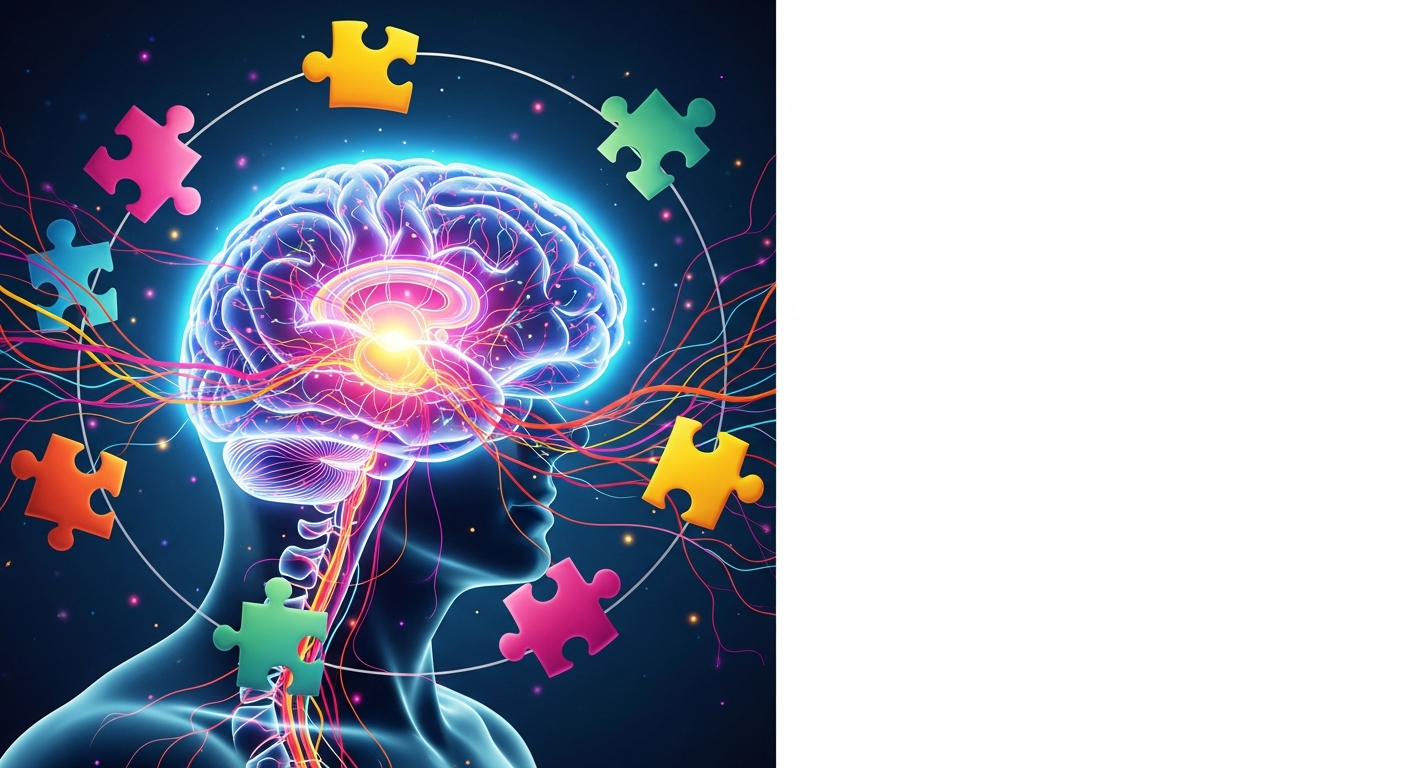
#Introduction: The Rise of the Digital Brain Gym
For decades, the gold standard of mental maintenance was the humble Sunday crossword or a quick game of Sudoku. We viewed these activities as the "jogging" of the mind—good for passing the time and perhaps keeping the gears turning. However, as our understanding of neurology has deepened, so too has our approach to mental fitness. We are currently witnessing the rise of the "Digital Brain Gym," a sophisticated ecosystem where brain training games are no longer just distractions, but precision-engineered tools designed to sharpen the human intellect.
Unlike traditional puzzles, modern cognitive games for adults are built on the back of rigorous psychological research. They don't just ask you to find a word in a grid; they challenge your processing speed, your ability to ignore distractions, and your capacity to hold multiple pieces of information at once. This shift represents a move toward "targeted cognitive supplementation," where we treat our mental faculties with the same intentionality we bring to our physical health at the gym.
But does playing a game on your smartphone actually make you smarter, or does it just make you better at the game? This is the central question facing the industry today. As we explore the science behind these tools, we find that the true value lies not in the high score on the screen, but in how those digital victories translate into a more capable, resilient version of yourself in everyday life.
Key Takeaway: The transition from passive puzzles to active brain training represents a shift toward intentional cognitive health, treating the brain as a muscle that requires specific, varied stimulation.
#The Science of Neuroplasticity: Can Games Really Change Your Brain?
At the heart of the brain training movement is the concept of neuroplasticity. For a long time, the scientific community believed that the adult brain was a static organ—that once you reached a certain age, your cognitive "hardware" was essentially fixed. We now know this is far from the truth. The brain is remarkably plastic, meaning it has the ability to reorganize itself by forming new neural connections throughout life in response to learning and experience.
When you engage in neuroplasticity exercises, you are essentially demanding that your brain find more efficient ways to process information. When a game presents a novel challenge that is "just hard enough," it triggers the release of neurotransmitters like dopamine and acetylcholine. these chemicals facilitate the strengthening of synapses, the junctions where neurons communicate. By repeatedly engaging these pathways, you aren't just memorizing a pattern; you are physically reinforcing the neural architecture responsible for that type of thinking.
However, the brain is also incredibly efficient—or "lazy," depending on how you look at it. If a task becomes too easy, the brain stops working hard and starts relying on automated routines. This is why the best cognitive enhancement tools utilize adaptive algorithms. They constantly adjust the difficulty level to keep you in the "Goldilocks Zone" of cognitive demand—not so hard that you give up, but not so easy that your brain goes on autopilot. This constant state of "desirable difficulty" is what drives actual structural change.
Key Takeaway: Neuroplasticity proves that the adult brain can rewire itself; however, meaningful change requires consistent, novel challenges that push the brain beyond its comfort zone.
#Key Benefits of Cognitive Games for Adults (Beyond High Scores)
When people start using cognitive games for adults, they often focus on their "Brain Index" or "Mental Age" scores provided by the app. While these metrics can be motivating, they are secondary to the functional benefits that these games aim to provide. The primary goal is the enhancement of "executive functions"—the high-level mental processes that allow us to plan, focus attention, remember instructions, and juggle multiple tasks successfully.
One of the most significant benefits is the improvement of "inhibitory control." This is the ability to ignore irrelevant stimuli and stay focused on the task at hand. In an age of constant digital notifications and open-office plans, this skill is more valuable than ever. Executive function training through digital games often involves tasks where you must respond to one signal while ignoring others, effectively training your brain to filter out the "noise" of modern life.
Furthermore, these games can significantly boost processing speed. As we age, the speed at which our brain processes visual and auditory information naturally slows down. By engaging in timed challenges that require rapid decision-making, adults can mitigate this decline. This isn't about becoming a "gamer"; it's about maintaining the mental quickness required to react to a sudden braking car or to follow a fast-paced conversation in a crowded room.
Key Takeaway: The real value of brain training lies in strengthening executive functions like focus and processing speed, which are essential for navigating the complexities of daily adult life.
#Memory Improvement Games: Moving From Short-Term Recall to Long-Term Retention
Memory is perhaps the most common concern for adults seeking out memory improvement games. We’ve all had that moment of walking into a room and forgetting why we’re there, or struggling to recall the name of a person we met just five minutes ago. Modern digital tools approach memory not as a single "bucket," but as a complex system involving working memory, episodic memory, and semantic memory.
Working memory is the "mental scratchpad" where we hold information temporarily while we use it. Many brain training games focus heavily on this area, challenging users to remember sequences or locations that change rapidly. Strengthening working memory is crucial because it serves as the gateway to long-term retention. If you can't hold a piece of information in your mind long enough to process it, it will never make the jump to your long-term memory stores.
To move beyond simple short-term recall, advanced digital brain health platforms incorporate "spaced repetition" and "elaborative encoding" techniques. These games don't just ask you to remember a list; they ask you to associate information with visual cues or place them within a narrative. This mimics the way our brains naturally store important information, making it easier to retrieve that information when you actually need it in the real world, such as during a presentation or while learning a new language.
Key Takeaway: Effective memory training targets working memory as a foundation, using structured challenges to improve the brain's ability to encode and retrieve information reliably.
#Choosing a Mental Agility App: Features to Look for in 2024
With hundreds of options in the app store, choosing the right mental agility app can be overwhelming. Not all apps are created equal; some are scientifically validated, while others are merely "brain-themed" entertainment. In 2024, a high-quality brain health app should offer more than just a variety of games. It should provide a personalized experience based on your specific cognitive goals and current baseline performance.
First, look for "Adaptive Difficulty." As mentioned earlier, if a game doesn't get harder as you get better, it's not training your brain; it's just a pastime. The app should use an algorithm that tracks your performance in real-time and adjusts the complexity to keep you challenged. Second, prioritize "Diversity of Training." A good app will have categories for memory, attention, language, math, and spatial reasoning. Training only one area is like only doing "leg day" at the gym; it leads to an unbalanced cognitive profile.
Finally, check for "Peer-Reviewed Research." The most reputable cognitive enhancement tools are often involved in clinical studies with universities. They should be transparent about their data and the specific cognitive theories their games are based on. Avoid apps that make "miracle" claims about curing diseases; instead, look for those that focus on measurable improvements in cognitive performance metrics and offer clear, easy-to-understand progress tracking.
Key Takeaway: Select an app that offers adaptive difficulty, a wide variety of cognitive challenges, and is backed by transparent, science-based methodologies.
#The Role of Puzzle Games for Brain Health: Why Complexity Matters
While brain training games are often specifically designed for "exercise," traditional puzzle games for brain health still play a vital role. Games like Portal, Baba Is You, or even complex strategy games like Civilization require a different kind of mental effort. These aren't just about reaction time; they are about systems thinking, logic, and long-term planning. They require the player to build a mental model of how a world works and then manipulate that model to solve a problem.
The "Complexity Factor" is key here. Simple puzzles provide a linear challenge, but complex games require "divergent thinking"—the ability to find multiple solutions to a single problem. This type of mental flexibility is a hallmark of high cognitive function. When you engage with a complex puzzle, you are exercising your "fluid intelligence," which is the capacity to think logically and solve problems in novel situations, independent of acquired knowledge.
Incorporating these more complex, "leisurely" puzzles alongside your structured training can prevent burnout. While a mental agility app might feel like a 15-minute workout, a deep puzzle game feels like a hobby. This variety ensures that you are hitting both the "sprint" (speed and memory) and the "marathon" (logic and strategy) aspects of cognitive health. The goal is a well-rounded mind that can handle both the quick-fire demands of a busy day and the deep-thinking requirements of a complex project.
Key Takeaway: Complex puzzle games complement structured brain training by fostering fluid intelligence and divergent thinking, providing a "deep-work" equivalent for the mind.
#The 'Transfer Effect': How Game Performance Translates to Real-World Skills
The "Transfer Effect" is the holy grail of digital brain health. It is the phenomenon where training on a specific task (like a digital game) leads to improvements in unrelated, real-world activities. Critics of brain training often argue that people just get better at the games themselves. However, the latest research suggests that "Far Transfer" is possible if the training targets the underlying core cognitive processes rather than specific game mechanics.
Consider the "Party Scenario." You're at a loud social gathering and you meet three new people. A brain training game that focuses on "divided attention" and "working memory" is directly training the faculties you need to hear their names over the music, associate those names with their faces, and keep that information "active" while you continue the conversation. You aren't "playing a game" at the party, but you are utilizing the reinforced neural pathways that the game helped build.
Similarly, in a professional setting, executive function training can translate to better "attentional switching." This is the ability to move from a deep-focus task (like writing a report) to an unexpected interruption (like an urgent Slack message) and then back to the original task without losing your place or your momentum. By training your brain to handle rapid shifts in information in a game environment, you reduce the "switching cost" in your actual work life, leading to higher productivity and less mental fatigue at the end of the day.
Key Takeaway: The 'Transfer Effect' ensures that the mental strength built during gaming translates into real-world benefits, such as better social recall and improved professional focus.
#Creating a Sustainable Routine: How Much Brain Training is Too Much?
Just like physical exercise, it is possible to overtrain your brain. Consistency is far more important than intensity when it comes to brain training games. Engaging in a marathon three-hour session once a week is significantly less effective than 15 to 20 minutes of daily practice. The brain needs time to consolidate what it has learned, often during sleep, so "little and often" is the golden rule for digital brain health.
A sustainable routine should also be varied. Our brains are designed to adapt to new stimuli, so if you do the exact same three games every single day, you will eventually hit a plateau where no further cognitive enhancement is occurring. Most experts recommend a "Circuit Training" approach: focus on memory on Monday, attention on Tuesday, problem-solving on Wednesday, and so on. This keeps the brain on its toes and ensures that all "muscle groups" of the mind are being addressed.
Finally, it’s important to listen to your "mental fatigue." If you find yourself getting frustrated or making simple mistakes you wouldn't normally make, it’s a sign that your cognitive resources are depleted. Brain training should feel like a challenge, but it shouldn't feel like a chore. The most successful users are those who integrate their mental agility app into a daily habit—perhaps during a morning coffee or a commute—ensuring that it becomes a permanent part of their lifestyle rather than a passing fad.
Key Takeaway: Consistency and variety are the pillars of a successful brain training routine; 15-20 minutes of daily, varied practice is the optimal "dose" for cognitive longevity.
#Conclusion: Building a Holistic Approach to Cognitive Longevity
In the quest for a sharper, more resilient mind, brain training games are a powerful ally, but they are not a silver bullet. True cognitive longevity comes from a holistic approach that combines these digital tools with other healthy habits. Physical exercise, a nutrient-dense diet, quality sleep, and active social engagement all work synergistically with cognitive games for adults to create an environment where the brain can thrive.
We have moved beyond the era of simple puzzles and into an age of "targeted cognitive supplementation." By understanding the science of neuroplasticity and the power of the transfer effect, we can use these tools to not only get better at games but to become better at life. Whether it’s remembering a name, staying focused during a long meeting, or simply feeling more "plugged in" to the world around you, the benefits of a well-trained mind are profound and far-reaching.
Ready to start your mental fitness journey? Don't just download an app and play aimlessly. Set a goal, choose a platform backed by science, and commit to 15 minutes a day. Your future self—sharp, focused, and cognitively resilient—will thank you. The digital brain gym is open; it’s time to start your first set.
Read next
See all →
Unlock Your Brain's Potential: The Power of Cognitive Games for Adults
Explore the transformative power of cognitive games designed for adults. Learn how engaging in these brain-training activities can enhance your memory, sharpen your focus, and boost overall mental agility, helping you unlock your brain's true potential.
The Science of Sharpness: Why a Daily Trivia Quiz is Your Best Morning Ritual
Start your day with a mental spark. This article explores the science behind daily trivia quizzes and how micro-learning habits can improve long-term cognitive health and focus.
The Power of the Daily Trivia Quiz: Why 10 Minutes a Day Makes You Smarter
Discover how a daily trivia quiz can transform your cognitive health through the power of micro-learning. Learn why spending just 10 minutes a day on a quiz of the day builds lasting general knowledge and sharpens your focus.