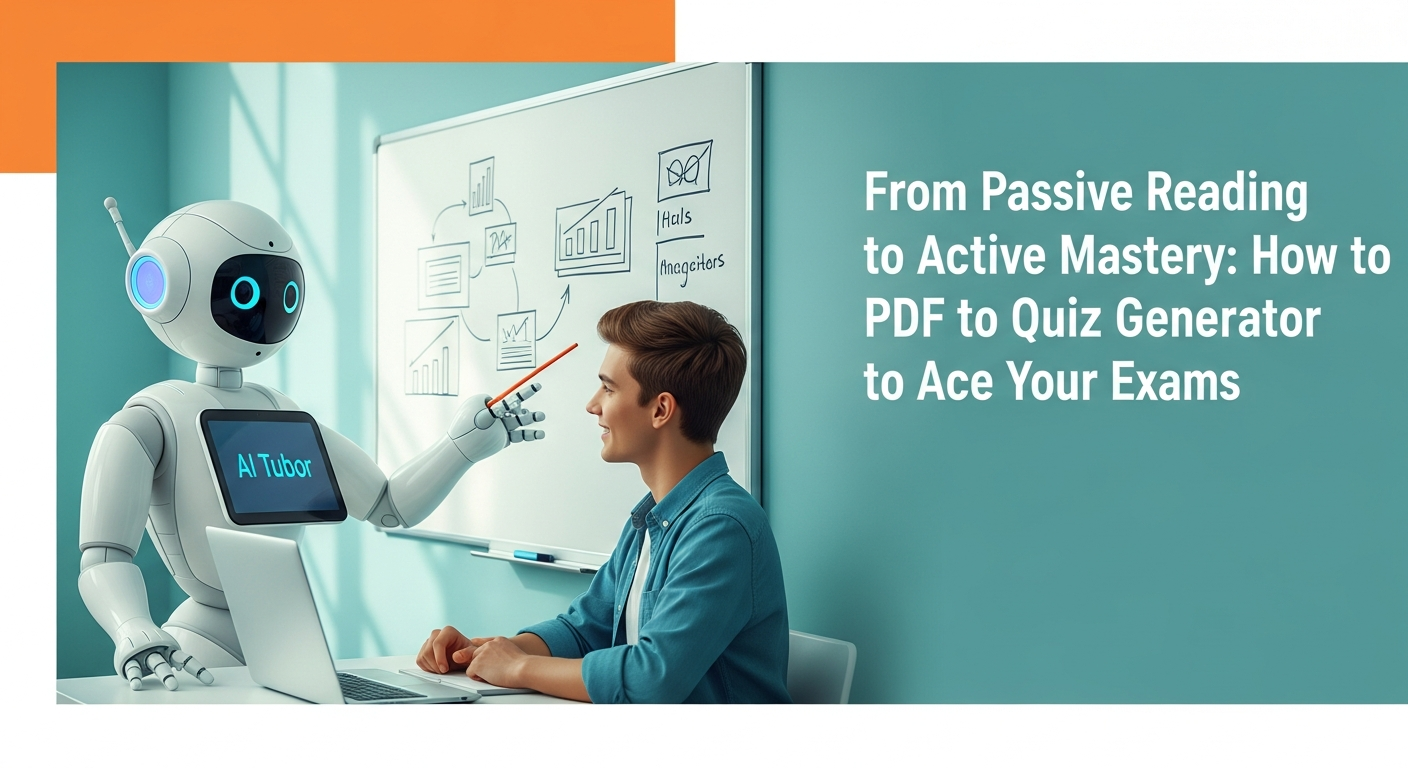
#Introduction: The 'Illusion of Competence' in Modern Studying
We have all been there: you spend six hours hunched over a desk, a neon yellow highlighter in hand, painting your textbook until every page looks like a radioactive glow-stick. You’ve read the chapter three times, your notes are meticulous, and you feel a sense of profound readiness. But when the exam paper lands on your desk the next morning, your mind goes blank. Why does the information that seemed so clear last night feel so unreachable now?
Psychologists call this the "Illusion of Competence." When we reread text or look at highlighted passages, our brains recognize the information, which we mistake for mastery. Recognition is passive; it’s the brain saying, "I’ve seen this before." Retrieval, however, is active; it’s the brain’s ability to pull information out of thin air. To truly ace your exams, you must move beyond the comfort of passive reading and embrace the friction of active testing. This is where a modern pdf to quiz generator becomes your most powerful academic ally.
In this guide, we will explore how leveraging an AI learning assistant to transform your static documents into dynamic assessments can bridge the gap between "reading" and "remembering." By the end of this article, you will understand how to turn your dense PDFs into a high-octane study engine that guarantees long-term retention.
Key Takeaway: Passive studying creates a false sense of security. To truly master a subject, you must shift from recognizing information to actively retrieving it through testing.
#What is a PDF to Quiz Generator and How Does the AI Work?
At its core, a pdf to quiz generator is an advanced software tool that uses Natural Language Processing (NLP) and Large Language Models (LLMs) to "read" and comprehend your study materials. Unlike simple keyword extractors of the past, today’s AI can understand context, hierarchy, and the relationship between complex concepts. When you convert pdf to quiz formats, the AI analyzes the syntax and semantics of your notes to identify the most critical "testable" information.
The process is surprisingly sophisticated. The AI scans your document, identifies key definitions, causal relationships, and significant data points. It then reformulates these facts into various question types—multiple choice, true/false, or short answer. It doesn't just copy-paste sentences; it rephrases them to ensure you are tested on the concept rather than just your ability to recognize a specific string of words.
For students dealing with hundreds of pages of material, this automated question generation from pdf saves hours of manual labor. Instead of spending your energy deciding what might be on the test, the AI provides a comprehensive baseline, allowing you to focus your cognitive energy on the actual act of learning and problem-solving.
Key Takeaway: Modern AI tools don't just scan text; they comprehend it, allowing for the creation of nuanced questions that test deep understanding rather than rote memorization.
#The Science of Active Recall: Why Converting Notes to Quizzes Beats Rereading
The effectiveness of active recall study tools is backed by decades of cognitive science. The "Testing Effect" suggests that the act of being tested on information actually strengthens the memory trace more than additional study time does. When you use an interactive study guide creator to quiz yourself, you are forcing your brain to work. This "desirable difficulty" signals to your hippocampus that the information is important and needs to be stored in long-term memory.
Rereading is like watching someone else lift weights at the gym; you might learn the form, but you won't get any stronger. Quizzing is the actual heavy lifting. Every time you struggle to remember an answer and then eventually find it (or see the correct answer), you are building more robust neural pathways. This process combats the "forgetting curve"—the natural tendency for the brain to discard information it doesn't think it needs.
Furthermore, using an ai quiz from notes provides immediate feedback. In passive reading, you don't know what you don't know until it’s too late. Quizzing exposes your "knowledge gaps" instantly. If you get a question wrong, you know exactly which section of the PDF you need to revisit. This targeted approach is significantly more efficient than re-reading an entire chapter to find one elusive concept.
Key Takeaway: Active recall is the "heavy lifting" of the brain. Quizzing yourself builds stronger memory pathways and reveals specific knowledge gaps that passive reading ignores.
#Step-by-Step Guide: How to Convert Your First PDF to a Quiz or Flashcard Deck
Ready to transform your study routine? The transition from a static PDF to an interactive session is simpler than you might think. First, select a high-quality pdf to quiz generator. Once you’ve chosen your platform, start by cleaning up your PDF. Ensure the text is selectable and free of excessive "noise" like margin notes or overlapping images, as this helps the AI maintain high accuracy during the automated question generation from pdf process.
Next, upload your document and select your parameters. Most tools allow you to choose the difficulty level and the number of questions. If your goal is a quick review, 10-15 questions might suffice. For a final exam, you might generate 50+. A great feature to look for is the ability to textbook to flashcards ai conversion. Flashcards are ideal for vocabulary and formulas, while quizzes are better for conceptual understanding and application.
Finally, review the generated questions. While AI is incredibly smart, it’s not infallible. Spend five minutes "vetting" the quiz to ensure the questions align with your instructor's focus. This review process is actually a "bonus" study session, as you are evaluating the importance of the material while you curate your custom exam. Once satisfied, export the quiz to your favorite platform or take it directly within the tool.
Key Takeaway: Streamline your workflow by cleaning your PDFs before upload and always spend a few minutes reviewing AI-generated questions to ensure they align with your specific learning goals.
#Beyond Basic Questions: Using AI to Generate Comprehensive Study Guides from Textbooks
While simple quizzes are great, the real power of an AI learning assistant lies in its ability to synthesize massive amounts of data. When you use a study guide generator from pdf, you aren't just getting a list of questions; you're getting a structured roadmap of the entire subject. This is particularly useful for massive textbooks where the sheer volume of information can feel paralyzing.
Advanced tools can break down a 500-page PDF into modular study guides. They can extract the "Big Ideas," list essential vocabulary, and even create summaries of complex processes. Instead of navigating a sea of text, you are presented with a tiered learning structure. You can start with the high-level summary, move to the vocabulary flashcards, and finish with a comprehensive quiz to verify your mastery.
This holistic approach ensures that you aren't just learning isolated facts in a vacuum. By using an interactive study guide creator, you see how Chapter 1 connects to Chapter 10. The AI can even be prompted to generate "application" questions—scenarios where you have to use the information to solve a problem—which is exactly what high-level university exams require.
Key Takeaway: Don't settle for just quizzes. Use AI to generate structured study guides that organize textbooks into manageable, interconnected modules for deeper conceptual understanding.
#Maximizing Efficiency: Integrating AI Quiz Tools into a Spaced Repetition Workflow
Generating a quiz is only half the battle; when you take that quiz matters just as much as the content itself. To achieve true mastery, you should integrate your pdf to quiz generator with spaced repetition software for students (like Anki or Quizlet). Spaced repetition is the practice of reviewing information at increasing intervals (e.g., 1 day, 3 days, 1 week, 1 month) to cement it into long-term memory.
Once you convert pdf to quiz format, take the test immediately to establish a baseline. Then, schedule your next session for two days later. If you get a question right easily, push the next review further out. If you struggle, bring it back sooner. Many AI tools now allow you to export your questions directly into flashcard formats that support this algorithmic scheduling.
This workflow eliminates the need for "cramming." By spending just 20 minutes a day engaging with your AI-generated quizzes over several weeks, you will retain more information than you would in a 12-hour marathon session the night before the exam. You are essentially hacking your brain’s biology to ensure the information stays put for the long haul.
Key Takeaway: Combine AI-generated content with spaced repetition algorithms to move information from short-term "cramming" memory to permanent long-term mastery.
#Common Pitfalls to Avoid When Using AI-Generated Study Materials
While active recall study tools are revolutionary, they are not a "magic button" that replaces the need for critical thinking. One common pitfall is "over-automation." If you generate a quiz and mindlessly click through the answers without reflecting on why an answer is correct, you are just performing a new type of passive learning. Engagement is the key ingredient that AI cannot provide for you.
Another risk is "AI Hallucination." Although rare with modern LLMs, AI can occasionally misinterpret a complex diagram or a highly technical sentence, leading to a factually incorrect question. Always treat your ai quiz from notes as a draft. If a question seems "off," go back to the source PDF to verify. This act of verification is actually a high-level cognitive task that further reinforces your learning.
Finally, avoid the trap of only testing what is easy to generate. AI is excellent at "What," "When," and "Who" questions. It is getting better at "Why" and "How," but it might still miss the subtle nuances your professor emphasized in class. Ensure you supplement your automated question generation from pdf with a few hand-written questions based on your lecture notes and specific "hints" dropped by your instructor during class time.
Key Takeaway: AI is a powerful co-pilot, not the pilot. Always verify AI-generated facts and ensure you are testing for "Why" and "How," not just "What" and "When."
#Conclusion: Building a Smarter, Not Harder, Study Routine
The journey from passive reading to active mastery is the single most important shift a student can make. By utilizing a pdf to quiz generator, you are no longer just a consumer of information; you become an active participant in your own education. You are moving away from the "Illusion of Competence" and toward a reality of proven knowledge and confidence.
Remember, the goal of using an AI learning assistant isn't just to save time—though it certainly does that—it's to improve the quality of your study hours. By focusing on active recall, utilizing spaced repetition, and leveraging the power of textbook to flashcards ai technology, you are equipping yourself with a professional-grade toolkit that makes acing exams a predictable outcome rather than a stressful gamble.
Don't let your valuable notes sit idle in a folder. Take your most challenging PDF today, run it through an interactive study guide creator, and see the difference that active retrieval makes. Stop reading, start testing, and watch your grades—and your confidence—reach new heights. Your future self, sitting calmly in that exam hall, will thank you.
Ready to transform your study habits? Upload your first PDF today and turn your notes into a personalized masterclass!
Read next
See all →
Unlocking Personalized Learning in 2024: How AI is Transforming Education
Explore the transformative impact of AI on personalized learning in 2024. From adaptive platforms to AI companions, discover tools that enhance education.
Transforming Learning: How AI Math Animation Makes Complex Concepts Click in 2023
Explore the transformative power of AI math animation tools in education. These innovative resources help students grasp complex mathematical concepts through engaging visuals.
Transform Your Study Routine in 2024: The Ultimate Guide to PDF to Quiz Generators
Transform your study routine in 2024 by utilizing PDF to quiz generators. This guide covers various tools, tips, and benefits to enhance your learning.