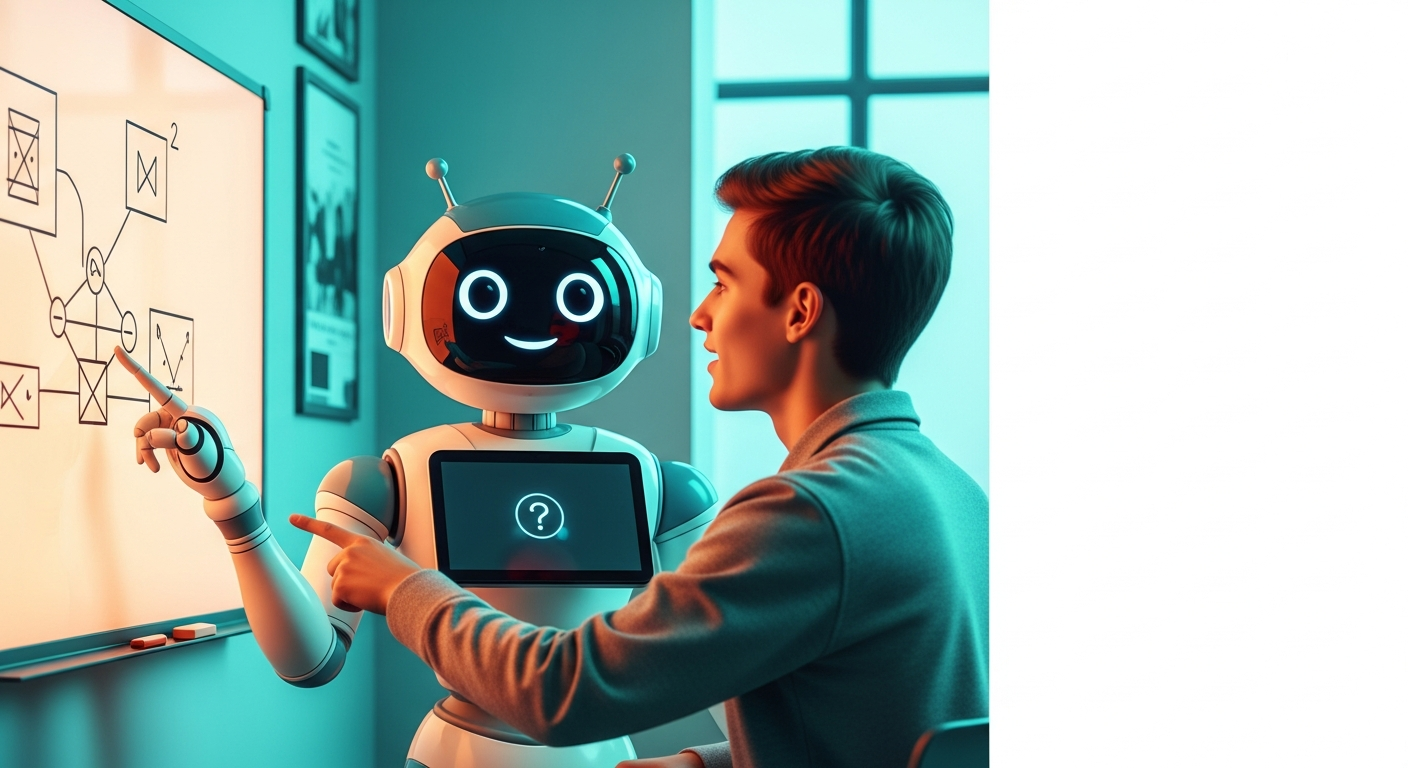
#Introduction: The Evolution of the Digital Classroom
For decades, the "digital classroom" was little more than a physical space with a few desktop computers or a learning management system that served as a glorified digital filing cabinet. We moved from chalkboards to whiteboards, and eventually to tablets, yet the fundamental model of education remained largely unchanged: one teacher, thirty students, and a one-size-fits-all curriculum. If a student fell behind during a lecture, they stayed behind until a parent could hire a private tutor or the student found the courage to ask for help after class.
Enter the era of generative AI in education. We are currently witnessing a seismic shift that is moving us away from static screens and toward dynamic, interactive environments. The emergence of the personalized AI tutor represents the most significant leap in pedagogical technology since the invention of the printing press. It is no longer about simply digitizing content; it is about creating a responsive, intelligent layer that wraps around the learner, providing support exactly when and where it is needed.
This evolution isn't just about efficiency; it's about equity and accessibility. In the past, high-quality, one-on-one tutoring was a luxury reserved for the affluent. Today, an ai tutor for students can provide that same level of personalized attention to anyone with an internet connection. We are stepping into a future where the digital classroom is no longer a place you go, but a personal mentor that travels with you, adapting to your unique pace, strengths, and curiosities.
Key Takeaway: The digital classroom has evolved from static content delivery to dynamic, AI-driven environments that offer personalized mentorship to every student, regardless of their location or socioeconomic status.
#Defining the AI Tutor: Moving Beyond Simple Search
To understand the power of a personalized AI tutor, we must first distinguish it from the tools that came before. For years, students used search engines like Google to find facts. While helpful, a search engine is a passive tool; it provides information but does not understand the student's struggle. A chatbot, while more interactive, often acts as a simple "answer engine," providing a direct response that can inadvertently bypass the actual learning process.
A true ai study companion is built on adaptive learning technology. It doesn't just store information; it models the student’s knowledge state. It knows that if you are struggling with a complex physics problem, you might actually be missing a foundational concept in algebra. Instead of just giving you the numerical answer, the AI tutor identifies the gap and guides you back to the prerequisite knowledge, ensuring that your cognitive foundation is rock-solid before moving forward.
This technology uses sophisticated algorithms to track progress over time, recognizing patterns in a student's mistakes and successes. It differentiates between a "careless error" and a "conceptual misunderstanding." By moving beyond simple search and basic chat, the AI tutor becomes a proactive partner in the educational journey, offering a level of nuance that was previously only possible through human-to-human interaction.
Key Takeaway: Unlike search engines or basic chatbots, a personalized AI tutor uses adaptive learning technology to identify knowledge gaps and provide context-aware guidance rather than just raw data.
#The Core Benefits: Why Every Student Needs a Personalized AI Tutor
The most immediate benefit of an ai tutor for students is the democratization of 24/7 virtual tutoring. Learning doesn't stop when the school bell rings, and some of the most intense "aha!" moments—or moments of deep frustration—happen at 9:00 PM over a kitchen table. Having an ai study companion available at any hour means that students are never "stuck" for long. This immediate feedback loop prevents the solidification of misconceptions and keeps the momentum of learning alive.
Furthermore, the AI tutor provides a "judgment-free zone." Many students hesitate to ask questions in a crowded classroom for fear of appearing slow or "dumb." An AI doesn't get frustrated, it doesn't judge, and it is happy to explain the same concept in ten different ways until it clicks. This emotional safety encourages students to take risks, admit what they don't know, and engage in the kind of vulnerable inquiry that is essential for AI for academic success.
Pacing is another critical factor. In a traditional classroom, the teacher must move at a speed that suits the "middle" of the class, often leaving advanced students bored and struggling students overwhelmed. A personalized AI tutor allows for radical differentiation. It can accelerate the curriculum for a student who has mastered the basics or provide extra practice modules for someone who needs more time. This ensures that every student is consistently working in their "Zone of Proximal Development"—the sweet spot where learning is challenging but achievable.
Key Takeaway: AI tutors provide 24/7 support, a judgment-free learning environment, and perfectly paced instruction, ensuring that students stay motivated and consistently challenged.
#The Socratic Difference: Why the Best AI Tutor Apps Don't Just Give Answers
The greatest concern regarding ai homework help is that it might become a "crutch" that does the thinking for the student. However, the best ai tutor app isn't an answer key; it’s a cognitive scaffold. This is where the "Socratic Shift" occurs. Instead of telling a student that the answer to a problem is "42," a Socratic AI asks: "What is the first step you would take to isolate the variable?" or "How does the pressure change if we decrease the volume of the container?"
Socratic AI learning mimics the ancient teaching philosophy of Socrates, who believed that the best way to learn was through a series of guided questions that lead the student to discover the truth themselves. By forcing the student to articulate their reasoning, the AI ensures that the student is building mental models rather than just memorizing steps. This leads to "deep learning"—the kind of understanding that persists long after the exam is over.
When an AI functions as a scaffold, it provides the minimum amount of help necessary to help the student take the next step. If the student is still lost, the AI provides a slightly larger hint, perhaps a visual analogy or a simplified example. This "scaffolding" is gradually removed as the student gains competence. This approach transforms the AI from a tool of convenience into a tool of empowerment, fostering critical thinking skills that are vital in the modern workforce.
Key Takeaway: The most effective AI tutors use the Socratic method to guide students toward their own "aha" moments, prioritizing deep conceptual understanding over quick answers.
#Top Use Cases: From Complex Calculus to Essay Brainstorming
The versatility of a personalized AI tutor makes it applicable across almost every academic discipline. In STEM subjects like Calculus or Chemistry, the AI can act as a step-by-step guide. It can visualize complex functions, simulate chemical reactions, or debug a line of Python code in real-time. For a student struggling with an integral, the AI can break the problem into smaller, manageable chunks, explaining the "why" behind each substitution or transformation.
In the humanities, the use cases are equally compelling. When it comes to essay brainstorming, an ai study companion can act as a high-level research partner. It can help a student refine a thesis statement, find counter-arguments to strengthen their position, or organize a messy outline into a coherent narrative. Rather than writing the essay for the student, the AI asks: "What evidence do you have to support this claim?" or "How might a critic interpret this historical event differently?"
Language learning is another area where AI excels. A student can engage in real-time conversation with an AI tutor in a target language, receiving instant corrections on grammar and pronunciation. Because the AI can simulate various scenarios—like ordering at a cafe in Paris or interviewing for a job in Tokyo—the student gains practical, conversational experience that textbooks simply cannot provide. This immersive, interactive practice is a cornerstone of modern AI for academic success.
Key Takeaway: From debugging code and solving calculus to refining essay structures and practicing foreign languages, AI tutors offer versatile, subject-specific support that enhances student performance across the board.
#How to Choose the Right AI Study Companion for Your Learning Style
Not all AI tools are created equal, and finding the best ai tutor app requires looking beyond the marketing hype. The first thing to consider is the pedagogical foundation of the tool. Does it simply provide answers, or does it utilize Socratic AI learning? A tool that prioritizes the "how" and "why" will always be more beneficial in the long run than one that acts as a shortcut. Look for apps that offer "step-by-step" modes and interactive dialogues.
Secondly, consider the level of personalization. A high-quality personalized AI tutor should allow you to input your specific curriculum, upload your class notes, or even specify your learning preferences (e.g., "I prefer visual analogies" or "I like concise, bulleted explanations"). The more the AI knows about your specific context, the more effective its scaffolding will be. Privacy is also paramount; ensure the platform has clear data protection policies, especially for younger students.
Finally, look for multi-modal capabilities. Some students learn best by reading, others by listening, and others by doing. The best ai study companion might offer a voice-chat feature for auditory learners, a whiteboard feature for visual learners, and interactive quizzes for kinesthetic learners. A tool that can adapt its output format to match your specific learning style will significantly increase your retention and engagement.
Key Takeaway: When selecting an AI tutor, prioritize tools that use the Socratic method, offer deep personalization based on your curriculum, and provide multi-modal ways to interact with information.
#Addressing the Elephant in the Room: AI Homework Help vs. Academic Integrity
The rise of ai homework help has sparked a massive debate about academic integrity. Critics argue that AI makes it too easy for students to cheat, potentially leading to a generation of learners who don't know how to think for themselves. This is a valid concern, but it stems from a misunderstanding of how these tools should be used. There is a fundamental difference between using AI to *bypass* work and using AI to *understand* work.
Educational institutions are beginning to realize that banning AI is neither practical nor productive. Instead, the focus is shifting toward "AI literacy." Students need to be taught how to use a personalized AI tutor ethically. This means using the AI to clarify concepts, get feedback on drafts, or generate practice problems, rather than asking it to generate a final submission. When used as a tutor rather than a ghostwriter, AI actually upholds academic integrity by ensuring the student truly masters the material.
Furthermore, teachers are evolving their assessment methods to account for AI. Instead of "take-home" essays that can be easily generated, educators are moving toward in-class discussions, oral exams, and "process-based" grading where students must show the various iterations of their work—including how they used AI to refine their thinking. In this new landscape, the AI becomes a documented part of the research and learning process, not a hidden shortcut.
Key Takeaway: Academic integrity in the age of AI depends on shifting the focus from "the answer" to "the process," teaching students to use AI as a mentor for understanding rather than a tool for completion.
#The Human Element: How AI Tutors Complement Traditional Teaching
A common fear is that the personalized AI tutor will eventually replace human teachers. However, the reality is quite the opposite: AI is poised to make the human element of teaching more important than ever. By taking over the repetitive tasks—grading basic quizzes, answering "when is the homework due," and providing basic remedial support—AI frees up teachers to do what they do best: inspire, mentor, and facilitate deep social learning.
When every student has a 24/7 virtual tutoring companion, the teacher no longer has to teach to the "average." They can walk into a classroom knowing exactly where each student stands based on the AI's data analytics. This allows the teacher to spend class time on collaborative projects, ethical debates, and complex problem-solving that requires human nuance, empathy, and social intelligence—things AI still cannot replicate.
The relationship between the student and the human teacher becomes more focused on high-level mentorship. The teacher becomes a "coach" who helps the student navigate their learning journey, using the data from the AI tutor to provide targeted interventions. In this hybrid model, the AI handles the "knowledge transfer," while the human teacher handles the "wisdom and application." This partnership creates a more robust and supportive educational ecosystem for everyone involved.
Key Takeaway: AI tutors do not replace teachers; they augment them by handling routine tasks and providing data, allowing educators to focus on high-impact mentorship and social-emotional learning.
#Conclusion: Preparing for a Future of Self-Directed Mastery
The shift beyond the chatbot toward the personalized AI tutor marks a turning point in human history. We are moving away from a world where education was a passive experience dictated by a rigid system, and toward a world of self-directed mastery. With an ai study companion in their pocket, every student has the power to take control of their own intellectual growth, breaking down the barriers of time, place, and difficulty.
The "Socratic Shift" is the key to this transformation. By using adaptive learning technology to challenge us rather than just satisfy us, AI helps us develop the most important skill of the 21st century: the ability to learn how to learn. As these tools become more sophisticated, the gap between "having information" and "having understanding" will continue to shrink, leading to a more informed, capable, and curious society.
Now is the time to embrace this technology. Whether you are a student looking for AI for academic success, a parent seeking better support for your child, or an educator looking to enhance your classroom, the future of learning is here. Don't just look for an answer—look for a partner in your journey toward mastery. Start exploring the world of AI tutoring today and discover how much further you can go when you have a mentor that never sleeps and always knows exactly what you need to hear next.
Ready to transform your study habits? Explore the latest in Socratic AI learning and find the study companion that fits your unique goals.
Read next
See all →
Unlocking Personalized Learning in 2024: How AI is Transforming Education
Explore the transformative impact of AI on personalized learning in 2024. From adaptive platforms to AI companions, discover tools that enhance education.
Transforming Learning: How AI Math Animation Makes Complex Concepts Click in 2023
Explore the transformative power of AI math animation tools in education. These innovative resources help students grasp complex mathematical concepts through engaging visuals.
Transform Your Study Routine in 2024: The Ultimate Guide to PDF to Quiz Generators
Transform your study routine in 2024 by utilizing PDF to quiz generators. This guide covers various tools, tips, and benefits to enhance your learning.