#Beyond the Chatbot: How to Find the Best AI Tutor for Students in 2024
Remember the days when a difficult math problem meant staring at a textbook for hours or waiting until Monday morning to ask your teacher for help? For decades, the "Google search" was the gold standard for student research, providing a static list of links that students had to sift through to find answers. But in 2024, the landscape of education has shifted fundamentally. We have moved from the era of information retrieval to the era of interactive mentorship.
Today’s students aren't just looking for answers; they are looking for guidance. The rise of generative AI for education has introduced a new player to the study hall: the AI tutor. Unlike a simple search engine, an ai tutor for students acts as a bridge between confusion and clarity, offering a level of interaction that was previously only available through expensive private tutoring. This shift represents a move toward "Learning-to-Learn," where the goal isn't just to finish the assignment, but to master the underlying concepts through continuous, personalized dialogue.
As we navigate this new frontier, it’s important to distinguish between a tool that does the work for you and a tool that helps you do the work better. The best AI tutors are designed to be Socratic mentors, nudging students toward the "Aha!" moment rather than simply handing over the final result. In this guide, we will explore how to find the best ai tutor app to suit your needs and how to leverage these tools to build 24/7 critical thinking skills.
Key Takeaway: The role of technology in education has evolved from providing static information to offering interactive, Socratic mentorship that prioritizes understanding over rote memorization.
#What Exactly is an AI Tutor?
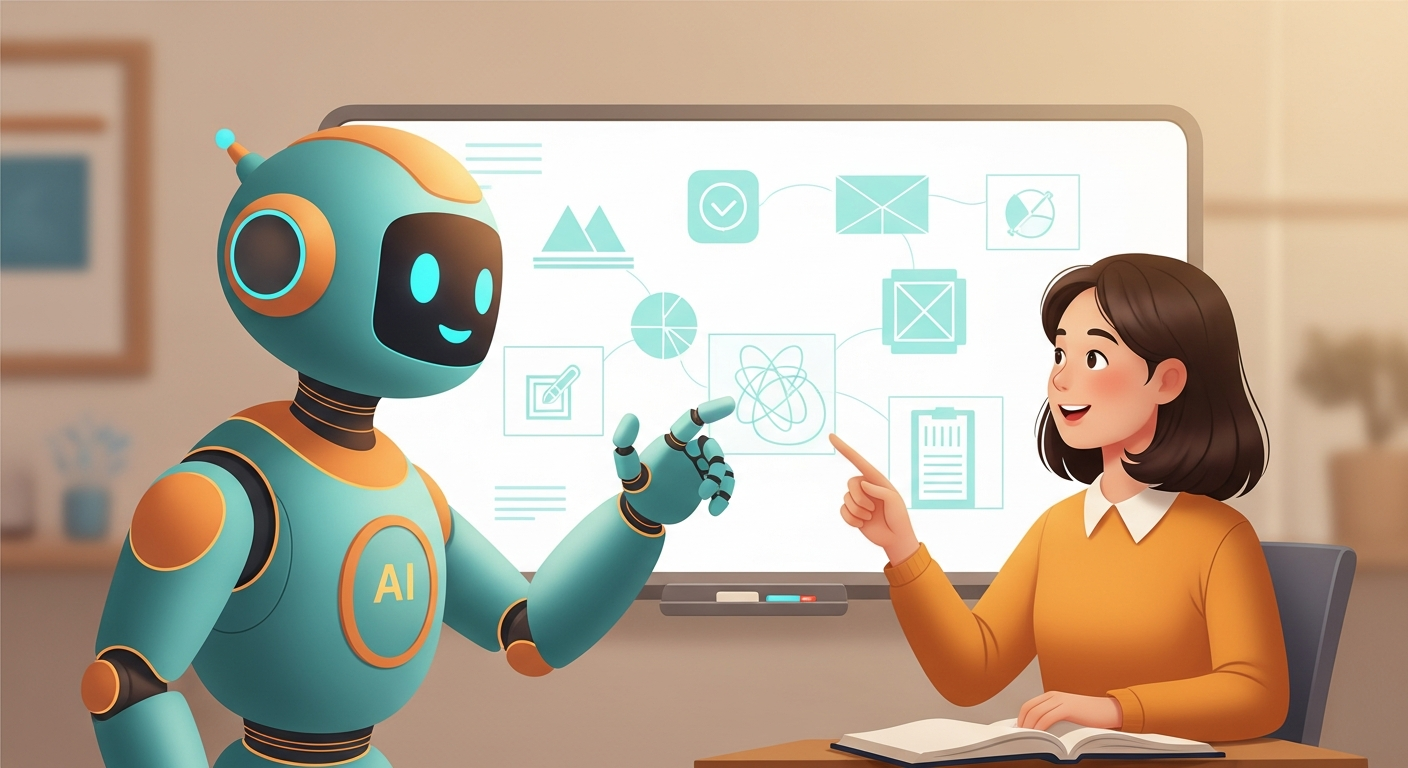
At first glance, you might think an AI tutor is just another name for a chatbot like ChatGPT. However, there is a significant difference between a general-purpose language model and a dedicated ai study companion. While a standard chatbot is designed to provide a direct response to a prompt, an AI tutor is built with pedagogical principles in mind. It is programmed to understand educational standards, recognize learning gaps, and employ teaching strategies that mirror human interaction.
A true AI tutor functions as a virtual teaching assistant. It doesn't just "know" things; it knows how to teach them. For example, if you ask a standard chatbot for the solution to a quadratic equation, it will likely provide the answer immediately. An AI tutor, conversely, might ask you what the first step of the quadratic formula is, or check if you’ve identified the coefficients correctly. This interactive loop is what transforms a piece of software into a genuine educational partner.
Furthermore, these tools are often integrated into adaptive learning platforms that track a student's progress over time. They remember which topics you’ve struggled with in the past and can tailor their explanations based on your specific learning style—whether you prefer visual analogies, step-by-step logic, or real-world examples. This level of customization is what makes the modern AI tutor a revolutionary force in the classroom and at home.
Key Takeaway: An AI tutor is more than a chatbot; it is a specialized educational tool designed to guide students through the learning process using pedagogical techniques rather than just providing instant answers.
#The Benefits of a Personalized AI Tutor: Why One-Size-Fits-All Learning is Over
One of the greatest challenges in traditional education is the "middle of the road" problem. In a classroom of thirty students, a teacher must often pace the lesson for the average learner, which can leave advanced students bored and struggling students left behind. A personalized ai tutor solves this by providing a "class of one" experience. The AI adapts to the student's pace, allowing them to spend five minutes on a concept they find easy and five hours on one they find difficult.
One of the primary AI tutoring benefits is the removal of the "fear of judgment." Many students hesitate to ask questions in class because they don't want to seem "slow" or "uninformed." An AI tutor provides a safe, low-stakes environment where a student can ask the same question ten different ways until they finally understand. This builds confidence and encourages a growth mindset, as the student realizes that mastery is a matter of persistence, not innate talent.
Additionally, the 24/7 study support offered by these apps means that learning is no longer tethered to school hours. Whether a student is a night owl finishing a history paper at 11 PM or an early riser prepping for a chemistry quiz at 6 AM, the AI tutor is always available. This accessibility ensures that the momentum of learning is never broken by a lack of immediate help, making the educational process more fluid and less frustrating.
Key Takeaway: Personalized AI tutors eliminate the "one-size-fits-all" limitation of traditional classrooms by adapting to each student's unique pace, style, and schedule.
#AI Homework Help vs. Deep Learning: How to Use AI to Actually Understand the Material
There is a common misconception that ai homework help is synonymous with cheating. If a student uses AI to write an entire essay or solve a math sheet without thinking, they are indeed bypassing the learning process. However, when used correctly, AI can be the ultimate tool for deep learning. The secret lies in how the student prompts the AI. Instead of asking "What is the answer?", the student should ask "Can you explain the logic behind this concept?" or "Can you give me a hint on where to start?"
Deep learning involves connecting new information to existing knowledge, and AI is exceptionally good at facilitating these connections. For instance, if a student is struggling with the concept of cellular respiration, they can ask their AI tutor to explain it using a metaphor involving a power plant or a kitchen. By seeing the material from different perspectives, the student develops a more robust mental model of the subject matter, which leads to better retention and higher exam scores.
The goal of using an ai study companion should be to eventually "fire" the tutor. By using the AI to break down complex problems into manageable steps, students learn the problem-solving frameworks themselves. Over time, they internalize the Socratic questions the AI asks, becoming more independent thinkers. This is the difference between using AI as a crutch and using it as a scaffold; one holds you up, while the other helps you build your own structure.
Key Takeaway: To avoid the "cheating" trap, students should use AI to deconstruct complex concepts and learn problem-solving frameworks rather than simply seeking final answers.
#Key Features to Look for in the Best AI Tutor App
With so many options hitting the market, how do you identify the best ai tutor app? Not all apps are created equal. A high-quality AI tutor should possess three key characteristics: a Socratic methodology, multi-modal input capabilities, and deep subject-matter expertise. The Socratic method is the most critical; the app should be programmed to ask guiding questions that lead the student to the answer, rather than just spitting out a solution.
Multi-modal input is another essential feature. Students don't just learn through text; they learn through images, diagrams, and voice. The best apps allow you to snap a photo of a handwritten physics problem or a complex biological diagram and interact with it. Being able to talk to your tutor via voice command can also be a game-changer for auditory learners or students with dyslexia who find typing cumbersome.
Finally, look for apps that offer specialized subject expertise. While a general AI might be okay at basic English, a specialized ai tutor for students might have specific modules for AP Calculus, LSAT prep, or coding in Python. These specialized modules are often grounded in specific curricula and textbooks, ensuring that the help the student receives is aligned with what they are actually being tested on in school.
Key Takeaway: The most effective AI tutors prioritize Socratic questioning, support multiple types of input (text, photo, voice), and offer specialized expertise in specific academic subjects.
#Top AI Tutors for Students in 2024: A Comparative Review
As we look at the landscape of 2024, several platforms have emerged as leaders in the field of adaptive learning platforms. One of the most prominent is Khanmigo, developed by Khan Academy. Khanmigo is specifically designed to be a Socratic tutor. It won't give you the answer to a math problem; instead, it will identify where you made a calculation error and ask you to try that step again. It’s an excellent choice for K-12 students who need a structured, safe environment.
Another heavy hitter is Socratic by Google. This app is fantastic for high school students who need quick, visual explanations. By taking a photo of a problem, Socratic finds the best online resources and provides its own step-by-step breakdowns. While it is slightly less conversational than Khanmigo, its ability to pull in diverse educational videos and diagrams makes it a top-tier ai homework help tool for visual learners.
For college-level students and those looking for deep technical support, Chegg’s AI integration and Quizlet’s Q-Chat are worth mentioning. Q-Chat acts as a personal study coach that quizzes you on your flashcards using spaced repetition, ensuring you don't just memorize terms for a day but actually learn them for the long term. Each of these tools has its own strengths, so the "best" app often depends on the student’s specific grade level and subject focus.
Key Takeaway: Platforms like Khanmigo and Q-Chat lead the market by focusing on pedagogical techniques like Socratic questioning and spaced repetition rather than simple information delivery.
#The Socratic Approach: How the Best AI Tutors Guide You to the Answer Instead of Giving It
The "Socratic Method" is named after the Greek philosopher Socrates, who believed that the best way to learn was through a series of questions that forced the student to examine their own logic. In the context of an ai tutor for students, this means the AI acts as a mirror for the student's thoughts. If a student says "I don't know how to solve this," the Socratic AI might respond, "What is the first thing we usually look for in this type of problem?"
This approach is vital because it builds critical thinking and metacognition—the ability to think about one's own thinking. When a student is forced to articulate their process, they identify their own misunderstandings. This is where the real "learning" happens. A virtual teaching assistant that uses this method ensures that the student is an active participant in the session, not a passive recipient of data.
By mimicking a human tutor’s tendency to "prompt and nudge," AI tools help students develop persistence. In a world where instant gratification is the norm, the Socratic approach teaches students that it’s okay to be stuck and that the process of getting "unstuck" is the most valuable part of education. This resilience is a transferable skill that will serve students long after they have graduated and entered the workforce.
Key Takeaway: The Socratic method used by top AI tutors fosters metacognition and critical thinking, turning the study process into an active journey of discovery.
#Integrating AI Into Your Routine: Study Tips for High School and College Students
To get the most out of an ai study companion, students need to integrate it strategically into their daily routines. It shouldn't be a "break glass in case of emergency" tool used only when a deadline is looming. Instead, try using it for "pre-learning." Before a lecture, ask the AI to give you a high-level summary of the topic. This creates a "mental coat rack" that makes it easier to hang new information during the actual class.
Another effective strategy is using the AI for self-quizzing. Once you think you’ve mastered a chapter, tell your AI tutor: "I just learned about the French Revolution. Can you quiz me on the economic causes and give me feedback on my answers?" This type of active recall is one of the most effective study techniques known to science. The AI can provide immediate feedback, correcting misconceptions before they become "baked in" to your memory.
Finally, use the AI to organize your study schedule. Many personalized ai tutor apps can help you break down a large project into smaller, manageable tasks. If you have a term paper due in three weeks, ask the AI to help you create a timeline for research, outlining, drafting, and editing. This reduces the cognitive load and helps prevent the procrastination that often stems from feeling overwhelmed.
Key Takeaway: Maximize AI benefits by using it for pre-learning, active recall through self-quizzing, and project management to build a consistent and effective study routine.
#Privacy and Academic Integrity: Using AI Responsibly and Safely
As with any powerful technology, using generative ai for education comes with responsibilities. The first is academic integrity. Students must understand their school’s specific policies regarding AI. While using an AI tutor to explain a concept is generally encouraged, using it to generate text that you turn in as your own is plagiarism. The rule of thumb is: use AI to power your brain, not to replace it. If the AI did the "thinking," you shouldn't be taking the credit.
Privacy is another critical concern. When using an ai tutor for students, be mindful of the data you share. Avoid inputting personal information, such as your full address or private life details, into the prompt. Most reputable educational AI companies have strict data privacy policies, but it is always wise to read the terms of service to understand how your data is being used to train future models.
Lastly, students should maintain a healthy skepticism. While AI is incredibly smart, it is not infallible. It can occasionally "hallucinate" or provide incorrect information with great confidence. Always cross-reference important facts with your textbook or teacher. Using AI should be a collaborative process where the student remains the "editor-in-chief" of their own education, verifying and validating the information provided by their digital assistant.
Key Takeaway: Responsible AI use involves adhering to academic integrity policies, protecting personal privacy, and maintaining a critical eye toward the accuracy of AI-generated information.
#Conclusion: Embracing the Future of Personalized Education
The transition from simple chatbots to sophisticated AI tutors marks a turning point in how we approach learning. We are moving away from a world where high-quality, personalized instruction was a luxury reserved for the few, and toward a world where every student has access to a 24/7 study support system. By choosing the best ai tutor app and using it as a Socratic mentor rather than a shortcut, students can unlock levels of understanding that were previously out of reach.
The goal of education has always been to prepare students for the challenges of the future. In 2024 and beyond, that future will undoubtedly involve AI. By mastering these tools today, students are not just learning history or math; they are learning how to navigate a world where human intelligence and artificial intelligence work in tandem. They are learning how to ask better questions, think more critically, and take ownership of their own intellectual growth.
Are you ready to transform your study habits? Don't just look for the answer—look for the understanding. Start exploring a personalized ai tutor today and experience the power of having a Socratic mentor in your pocket. The future of education is here, and it is more interactive, accessible, and personalized than ever before. Embrace the tools, do the work, and watch your critical thinking skills soar.
Final Thought: The best way to predict the future of your education is to create it. Use AI to challenge yourself, ask deeper questions, and become the master of your own learning journey.
Read next
See all →
Unlocking Personalized Learning in 2024: How AI is Transforming Education
Explore the transformative impact of AI on personalized learning in 2024. From adaptive platforms to AI companions, discover tools that enhance education.
Transforming Learning: How AI Math Animation Makes Complex Concepts Click in 2023
Explore the transformative power of AI math animation tools in education. These innovative resources help students grasp complex mathematical concepts through engaging visuals.
Transform Your Study Routine in 2024: The Ultimate Guide to PDF to Quiz Generators
Transform your study routine in 2024 by utilizing PDF to quiz generators. This guide covers various tools, tips, and benefits to enhance your learning.