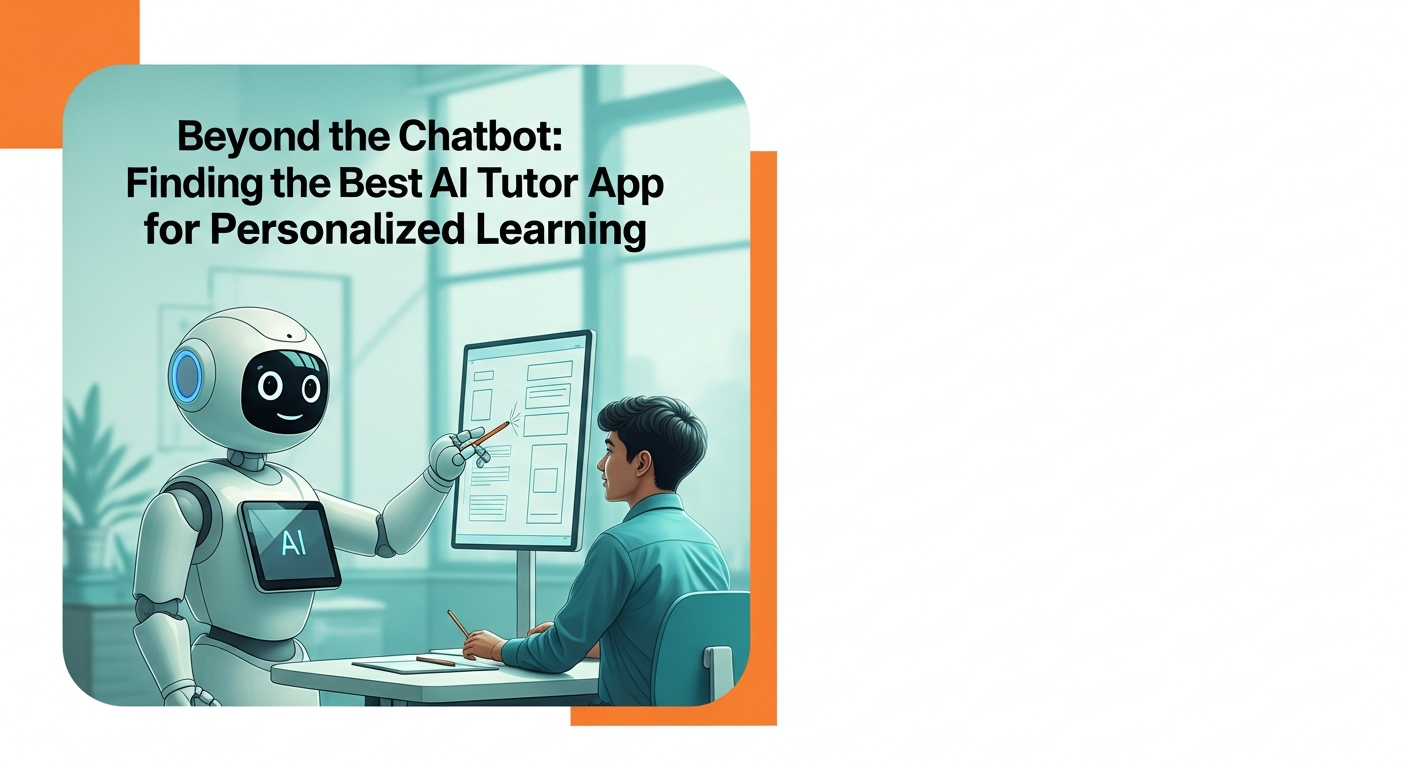
#Introduction: The Evolution of the Study Hall
The image of the traditional study hall is changing. It used to be a physical space—a quiet library corner or a cluttered bedroom desk—where students grappled with textbooks and handwritten notes in isolation. If you hit a wall with a complex calculus problem or a confusing historical timeline at 11:00 PM, your options were limited: wait for class the next day, call a friend who might be just as confused, or simply give up. However, the digital revolution has birthed a new era of AI-powered education, transforming how students interact with information and overcome academic hurdles.
We have moved past the era of simple search engines and basic encyclopedic queries. Today, the "study hall" exists in the cloud, accessible from any device at any time. The emergence of the ai tutor for students has redefined the boundaries of academic support, offering a level of immediacy that was previously impossible. But as we navigate this new landscape, a critical distinction is emerging. It is no longer just about finding a tool that provides answers; it is about finding a pedagogical partner that fosters true understanding.
In this article, we will explore why the best ai tutor app is much more than a sophisticated chatbot. We will delve into how these adaptive learning tools are shifting the focus from rote memorization to conceptual mastery, and how you can identify the right ai study companion to navigate your unique educational journey.
Key Takeaway: The modern study hall is no longer a physical location but a digital ecosystem where AI serves as a constant, interactive bridge between confusion and clarity.
#What Exactly is an AI Tutor for Students?
At its core, an ai tutor for students is a specialized application of generative AI designed specifically for pedagogical purposes. Unlike a general-purpose AI that might write a poem or summarize a news article, an interactive learning assistant is programmed with educational frameworks in mind. It understands that the goal of education is not the completion of a task, but the acquisition of knowledge and skills. These tools leverage large language models (LLMs) but are often "fine-tuned" or layered with specific educational data to ensure accuracy and safety.
An effective AI tutor acts as a bridge between a student's current knowledge and their learning goals. It uses natural language processing to engage in dialogue, allowing students to ask questions in plain English rather than rigid search queries. Whether it's explaining the nuances of Shakespearean metaphors or breaking down the laws of thermodynamics, the AI adapts its language and complexity to the student's grade level and prior understanding. This creates a highly personalized ai tutor experience that mimics the one-on-one attention once reserved for those who could afford private human tutoring.
Furthermore, these tools are increasingly becoming adaptive learning tools. This means they don't just present the same information to every user; they analyze the student's performance, identify gaps in their logic, and adjust the curriculum in real-time. If a student struggles with fractions, the AI won't just move on to decimals; it will provide extra practice and alternative explanations until the foundational concept is solidified. This ensures that no student is left behind by a one-size-fits-all classroom pace.
Key Takeaway: An AI tutor is a specialized educational partner that uses natural language and adaptive algorithms to provide tailored support, moving beyond simple information retrieval.
#Personalized AI Tutor vs. Generic Chatbots: Why Context Matters
It is tempting to think that any generative AI, like a standard chatbot, can serve as a tutor. However, there is a fundamental difference between a "search-and-summarize" tool and a personalized ai tutor. Generic chatbots are designed to be helpful assistants across all domains, which often leads them to provide direct answers immediately. While this is great for writing an email, it is detrimental to the learning process. If a student asks a generic bot for the answer to a math problem, the bot gives the answer. The student completes the homework, but their brain hasn't done the work required to learn the concept.
In contrast, the best ai tutor app understands the context of a "learning moment." It recognizes that providing the answer is often the least helpful thing it can do. Instead, a dedicated ai study companion is programmed to guide the student through the process. It might ask, "What do you think the first step should be?" or "Can you explain why you chose that formula?" This contextual awareness transforms the AI from a sophisticated cheat sheet into a genuine mentor. It prioritizes the "how" and "why" over the "what."
Moreover, personalized AI tutors maintain a "memory" of a student’s progress. They know which topics the student has mastered and where they consistently struggle. A generic chatbot treats every interaction as a blank slate. By maintaining a longitudinal view of the student's academic journey, the personalized ai tutor can offer proactive support, reminding the student of a concept they learned last week that applies to the problem they are solving today. This continuity is what makes AI a powerful interactive learning assistant rather than a temporary fix.
Key Takeaway: Context is the "secret sauce" of AI tutoring; while generic bots give answers, personalized AI tutors guide the thinking process and maintain a long-term understanding of the student's needs.
#The Benefits of Having a 24/7 AI Study Companion
One of the most significant barriers to academic success is the "bottleneck of support." Teachers have limited hours, and parents may not always have the expertise to help with advanced subjects. This is where the 24/7 academic support provided by an AI tutor becomes a game-changer. Learning doesn't happen on a strict 9-to-5 schedule; it happens during late-night study sessions, early morning reviews, and weekend projects. Having an ai study companion available at any hour ensures that a student's momentum is never halted by a lack of guidance.
Beyond mere availability, an AI tutor provides a "psychologically safe" environment for learning. Many students feel anxious about asking "dumb" questions in a crowded classroom or admitting they don't understand a concept to a teacher. The AI is infinitely patient and entirely non-judgmental. A student can ask the same question ten different ways without feeling embarrassed. This freedom to fail and experiment is crucial for developing a growth mindset, allowing students to take risks in their learning that they might otherwise avoid.
Additionally, the best ai tutor app can help with time management and organization. By breaking down large assignments into smaller, manageable tasks, the AI helps reduce the overwhelm that often leads to procrastination. It can serve as a sounding board for brainstorming or a proofreader for early drafts, providing instant feedback that allows students to iterate and improve their work in real-time. This constant feedback loop is one of the most effective ways to accelerate the learning process.
Key Takeaway: 24/7 access to a non-judgmental AI companion removes the fear of failure and ensures that support is available whenever the "lightbulb moment" is ready to strike.
#Beyond AI Homework Help: Learning How to Solve, Not Just What to Write
The term ai homework help often carries a negative connotation, suggesting a shortcut to avoid work. However, the next generation of AI-powered education tools is reclaiming this term by focusing on the Socratic method. Instead of being "answer engines," these tools act as "Socratic mentors." The goal is not to produce a finished essay or a solved equation, but to lead the student to those conclusions through guided inquiry. This is the difference between giving a man a fish and teaching him how to fish.
When a student uses an interactive learning assistant that employs the Socratic method, the interaction becomes a dialogue. If a student is stuck on a chemistry problem regarding molecular bonds, the AI won't just list the bonds. It might ask the student to identify the elements involved and recall their positions on the periodic table. By prompting the student to retrieve information they already know and apply it to a new problem, the AI strengthens the neural pathways associated with that knowledge. This leads to deeper retention and the ability to apply the concept to future, more complex problems.
This shift from "what to write" to "how to solve" is essential for preparing students for a world where information is cheap, but critical thinking is invaluable. The best ai tutor app will challenge a student's assumptions and encourage them to defend their logic. This process of active engagement turns a passive recipient of information into an active participant in their own education. It transforms ai homework help from a potential crutch into a powerful cognitive scaffold.
Key Takeaway: True AI tutoring uses the Socratic method to build critical thinking skills, ensuring students master the underlying logic rather than just finding the path of least resistance to an answer.
#Key Features to Look for in the Best AI Tutor App
With the market flooded with new tools, how do you identify the best ai tutor app for your needs? It starts with looking beyond the chat interface. First and foremost, look for adaptive learning tools that offer "multi-modal" support. A top-tier AI tutor should be able to process text, images (like a photo of a handwritten math problem), and even voice. This flexibility allows students to interact in the way that feels most natural to them and ensures the AI can handle diverse subjects from geometry to foreign languages.
Second, prioritize apps that offer "step-by-step" guidance rather than immediate solutions. The interface should encourage exploration. Features like "Hint" buttons, "Explain the Logic" toggles, and "Practice Similar Problems" are hallmarks of a tool designed for genuine learning. Furthermore, the personalized ai tutor should have a robust safety framework. It should be designed to refuse requests to simply "write my essay" and instead offer to "help me outline my ideas" or "check my grammar and flow."
Finally, consider the integration capabilities. Does the ai study companion align with standard curricula (like AP, IB, or Common Core)? Can it save your progress across devices? Does it provide a dashboard for parents or teachers to see where the student is excelling or struggling? The best tools are those that don't exist in a vacuum but integrate seamlessly into the student's broader educational ecosystem, providing actionable insights that can be used in the classroom.
Checklist for Choosing an AI Tutor:
- Socratic Questioning: Does it ask questions to lead you to the answer?
- Multi-modal Input: Can it read your diagrams or listen to your pronunciation?
- Curriculum Alignment: Is it grounded in verified educational standards?
- Progress Tracking: Does it remember what you've learned over time?
- Ethical Guardrails: Does it prevent cheating while encouraging learning?
Key Takeaway: The best AI tutor apps prioritize pedagogical features like Socratic dialogue and curriculum alignment over simple answer generation.
#The Human-AI Synergy: Balancing Technology with Traditional Teaching
Despite the incredible capabilities of generative AI for education, it is important to remember that technology is not a replacement for human teachers. Instead, we are entering an era of "Human-AI Synergy." The role of the teacher is evolving from a primary source of information to a high-level mentor and facilitator. When students use an ai tutor for students to handle the foundational "drilling" and basic concept explanations, it frees up valuable classroom time for deep discussions, collaborative projects, and social-emotional learning.
Think of the AI as a teaching assistant that works 1-on-1 with every student simultaneously. While the AI handles the repetitive task of explaining the Pythagorean theorem for the fifth time to a struggling student, the teacher can focus on helping another student apply that theorem to an architectural design project. This AI-powered education model allows for a level of differentiation that was previously a logistical nightmare for a single teacher with thirty students.
The human element remains essential for inspiration, empathy, and complex moral reasoning—areas where AI still falls short. A teacher can recognize when a student's lack of progress is due to a personal issue rather than a cognitive gap. They can provide the encouragement and mentorship that builds a student's confidence. The best ai tutor app acts as a force multiplier for the teacher's expertise, ensuring that every student gets the specific support they need when they need it, while the teacher provides the overarching vision and human connection.
Key Takeaway: AI is a powerful tool for personalization, but it works best when it complements, rather than replaces, the irreplaceable guidance and empathy of a human educator.
#Ethical Use: How to Use AI Without Risking Academic Integrity
As ai homework help becomes more prevalent, the conversation around academic integrity has never been more important. There is a fine line between using an interactive learning assistant to enhance your understanding and using it to bypass the learning process entirely. To use AI ethically, students must view it as a "tutor," not a "ghostwriter." The goal should always be to reach a point where you can solve the problem or write the essay *without* the AI's help.
One practical way to maintain integrity is to use the AI for the "pre-work" and "post-work" of an assignment. Use it to brainstorm topics, create an outline, or explain a concept you don't understand. Then, close the AI and do the actual writing or problem-solving yourself. Finally, you can use the ai study companion to review your completed work and suggest areas for improvement. This ensures that the intellectual "heavy lifting" is done by the student, which is the only way true learning occurs.
Transparency is also key. Many educators are open to the use of AI if it is disclosed and used as a tool for exploration. Students should be encouraged to show their "AI-assisted" process—perhaps by turning in an outline generated through a Socratic dialogue with their personalized ai tutor alongside their final paper. By shifting the focus from the final product to the process of discovery, we can mitigate the risks of plagiarism and ensure that generative AI for education remains a force for good.
Key Takeaway: Academic integrity in the age of AI depends on using the technology to build your own skills, ensuring that the student—not the machine—is the primary author of their own knowledge.
#Conclusion: Preparing for a Future of AI-Enhanced Learning
The rise of the ai tutor for students marks a pivotal moment in the history of education. We are moving away from the "industrial model" of schooling—where every student moves at the same pace through the same material—and toward a future of truly personalized ai tutor experiences. By embracing the best ai tutor app as a Socratic mentor rather than a shortcut, students can unlock a deeper level of understanding and a more resilient set of critical thinking skills.
As these adaptive learning tools continue to evolve, they will become even more intuitive, more integrated, and more capable of supporting diverse learning needs. The key for students, parents, and educators is to approach this technology with a clear focus on the ultimate goal: the cultivation of a curious, capable, and independent mind. AI-powered education is not about making learning "easier" in the sense of avoiding effort; it's about making it more effective by ensuring that effort is directed toward meaningful mastery.
Are you ready to transform your study habits and take control of your learning journey? Start by exploring how an interactive learning assistant can help you tackle your toughest subjects. Don't just look for the answer—look for the understanding. The future of learning is here, and it’s personalized, 24/7, and more engaging than ever before. Embrace the power of the ai study companion today and discover what you are truly capable of achieving.
Read next
See all →
Unlocking Personalized Learning in 2024: How AI is Transforming Education
Explore the transformative impact of AI on personalized learning in 2024. From adaptive platforms to AI companions, discover tools that enhance education.
Transforming Learning: How AI Math Animation Makes Complex Concepts Click in 2023
Explore the transformative power of AI math animation tools in education. These innovative resources help students grasp complex mathematical concepts through engaging visuals.
Transform Your Study Routine in 2024: The Ultimate Guide to PDF to Quiz Generators
Transform your study routine in 2024 by utilizing PDF to quiz generators. This guide covers various tools, tips, and benefits to enhance your learning.