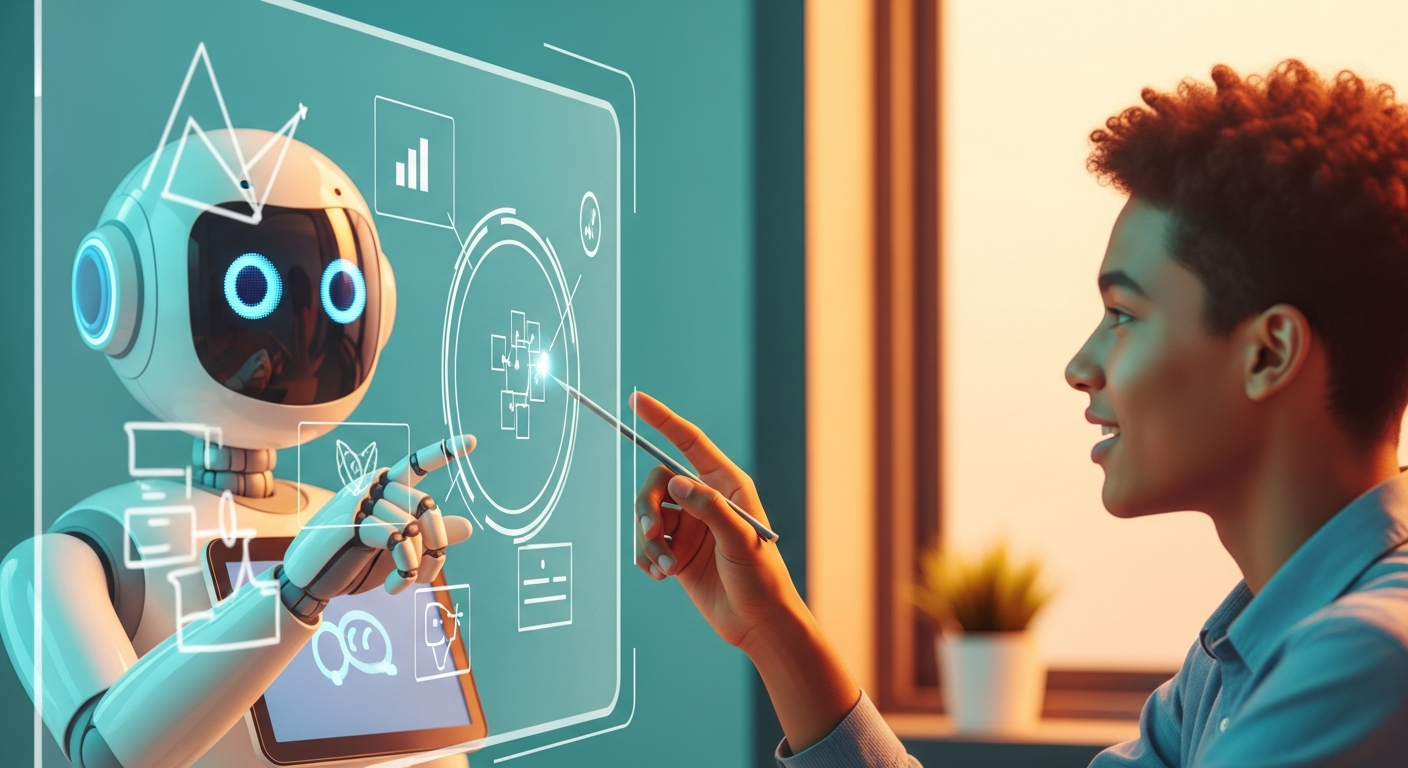
#Introduction: The Shift from Search Engines to Study Partners
For decades, the ritual of "doing homework" followed a predictable, often frustrating path. When a student hit a wall with a complex calculus problem or struggled to interpret a Shakespearean sonnet, the options were limited: wait until class the next day, ask a busy parent, or dive into the bottomless pit of a search engine. While search engines provided information, they lacked context. They offered a million "whats" but very few "hows" and "whys." Today, we are witnessing a paradigm shift as students move away from passive search results toward an active ai study companion.
This evolution isn't just about speed; it's about the nature of the interaction. We are entering the era of the personalized AI tutor—a tool that doesn't just store information but understands how to communicate it. Unlike a static website, an ai tutor for students acts as a dynamic partner in the learning process. It recognizes when a student is frustrated, identifies specific gaps in foundational knowledge, and adapts its teaching style in real-time. This is the transition from a digital encyclopedia to a digital mentor.
The real magic, however, lies in the "Socratic" approach. Instead of merely providing a shortcut to the finish line, the modern AI learning assistant is being designed to challenge the student. It asks the right questions at the right time, guiding the learner toward their own "aha!" moments. This article explores how this technology is redefining success by focusing on deep comprehension rather than just task completion.
Key Takeaway: The shift from search engines to AI tutors marks a move from passive information retrieval to active, personalized mentorship that prioritizes understanding over simple answers.
#What is a Personalized AI Tutor? (Defining the Technology)
At its core, a personalized AI tutor is a sophisticated application of generative AI in education. Unlike traditional educational software that follows a rigid, "if-then" logic, these systems are powered by Large Language Models (LLMs) and adaptive learning technology. This means the tutor learns about the student as the student learns about the subject. It tracks progress, remembers previous mistakes, and tailors its explanations to the user's current level of mastery.
Think of it as a bespoke suit for the mind. If one student learns best through visual metaphors and another through step-by-step logic, the AI adjusts its output accordingly. This level of customization was once only available to those who could afford expensive private human tutoring. By leveraging AI, this high-touch educational experience is becoming democratized, allowing students from all backgrounds to access a high-quality ai study companion that fits their unique cognitive profile.
Furthermore, these tutors are not just text-based bots. They are increasingly multimodal, capable of "seeing" a handwritten math problem via a camera or "hearing" a student practice a foreign language. This holistic approach ensures that the technology isn't just a gimmick but a robust educational tool capable of handling the nuances of diverse academic disciplines.
Key Takeaway: Personalized AI tutors use adaptive learning technology to create a custom educational experience, making high-level mentorship accessible and scalable for all students.
#The Benefits of an AI Study Companion: Why 24/7 Support Matters
One of the most significant hurdles in modern education is the "bottleneck of help." Teachers are often responsible for 30 or more students, making it impossible to provide immediate, individualized feedback to everyone. This is where 24/7 student support through AI becomes a game-changer. Learning doesn't just happen between 8:00 AM and 3:00 PM; it happens during late-night study sessions, weekend projects, and early morning reviews. Having an ai tutor for students available at any hour ensures that a moment of confusion doesn't turn into a night of discouragement.
Beyond availability, an AI companion offers a "judgment-free zone." Many students hesitate to ask questions in class for fear of appearing "slow" or "uninformed." An AI doesn't get tired, and it certainly doesn't judge. A student can ask the same question ten different ways until the concept finally clicks. This psychological safety encourages curiosity and persistence, two traits that are essential for long-term academic success. When the fear of judgment is removed, the barrier to learning disappears.
Additionally, the consistency of an AI tutor provides a stable foundation for students with varying schedules. Whether a student is an athlete traveling for games or a working student balancing a job, their ai study companion is always ready to pick up exactly where they left off. This continuity prevents the "learning loss" that often occurs when a student is forced to pause their studies due to external life pressures.
Key Takeaway: 24/7 AI support provides a judgment-free, always-available resource that removes the psychological and logistical barriers to seeking help.
#AI Homework Help vs. Academic Integrity: How to Learn, Not Just Finish
The rise of ai homework help has sparked a massive debate regarding academic integrity. Critics argue that AI makes "cheating" easier than ever. However, the problem isn't the technology; it's how the technology is utilized. If a student uses AI to simply generate an essay or solve a math equation without understanding the process, they aren't learning. But when framed correctly, an AI tutor can actually be the greatest enemy of academic dishonesty because it emphasizes the *process* of reaching the answer.
The best ai tutor app doesn't just give the answer; it shows the work and explains the "why." Instead of writing a paragraph for a student, a sophisticated AI might say, "I see you're trying to analyze the theme of ambition in Macbeth. What are some specific actions Macbeth took that show his desire for power?" By prompting the student to provide the evidence, the AI ensures the student remains the "author" of their own knowledge. This shift from "answer engine" to "learning engine" is what preserves academic integrity.
Educators are now beginning to encourage the use of AI as a brainstorming partner or a "first-draft critic." By using AI to check their own logic or to find counter-arguments for their thesis, students engage in higher-order thinking. In this context, generative AI in education becomes a tool for empowerment rather than a shortcut for laziness. It transforms homework from a chore to be completed into a challenge to be mastered.
Key Takeaway: Academic integrity is preserved when AI is used as a guide to facilitate the learning process rather than a tool to bypass it.
#Key Features to Look for in the Best AI Tutor App
With the market flooded with new tools, how do you identify the best ai tutor app? The first feature to look for is "Contextual Awareness." A high-quality tutor should allow you to upload your specific syllabus, textbook chapters, or class notes. This ensures the AI isn't just giving general information but is helping you master the specific material your teacher expects you to know. Without this context, an AI is just a generalist; with it, it becomes a specialist in your specific curriculum.
Second, look for "Multi-Step Explanation" capabilities. Avoid apps that provide "one-click answers." Instead, seek out platforms that break down complex problems into manageable chunks. For example, in a chemistry problem, the AI should guide you through balancing the equation step-by-step, checking your understanding at each interval. This interactive feedback loop is what differentiates a true personalized ai tutor from a basic chatbot.
Finally, the user interface should prioritize "Active Recall" and "Spaced Repetition." The best apps will periodically quiz you on concepts you struggled with in the past to ensure the information has moved into your long-term memory. Features like flashcard generation, practice test creation, and progress tracking are essential for any ai study companion aiming to make a lasting impact on a student's GPA and confidence.
Key Takeaway: The best AI tutoring apps offer contextual awareness, step-by-step guidance, and features that promote long-term retention like active recall.
#Subject Mastery: Using AI for Math, Science, and Humanities
One of the most impressive aspects of an ai tutor for students is its versatility across disciplines. In mathematics, AI can act as a dynamic whiteboard. It can visualize geometric shapes, graph complex functions, and help students identify exactly where a calculation went wrong. Instead of just seeing a red "X" on a test paper, the student receives an immediate explanation: "It looks like you forgot to distribute the negative sign in the second step. Let's try that part again."
In the sciences, AI excels at explaining abstract concepts through relatable analogies. Whether it's the nuances of cellular respiration or the laws of thermodynamics, a personalized ai tutor can simplify the language or dive deep into the technical details depending on the student's needs. It can simulate lab environments or help students analyze data sets, making the scientific method feel more interactive and less like rote memorization.
For the humanities, AI serves as a powerful sounding board for critical analysis. It can help students outline essays, refine their thesis statements, or understand the historical context of a literary work. By acting as a 1-on-1 debate partner, the AI can challenge a student's perspective, forcing them to find stronger evidence and develop more persuasive arguments. This cross-disciplinary utility makes the AI learning assistant an indispensable tool for the modern polymath.
Key Takeaway: Whether it's solving equations or analyzing literature, AI tutors adapt their methodology to provide subject-specific support that enhances mastery.
#The 'Socratic Method' in AI: How Top Tutors Encourage Critical Thinking
The most transformative feature of next-generation AI is Socratic AI tutoring. Named after the Greek philosopher Socrates, this method involves a cooperative argumentative dialogue to stimulate critical thinking and to draw out ideas and underlying presuppositions. Instead of being a "sage on the stage" who lectures, the AI becomes a "guide on the side" who asks questions. This is the "unique angle" that separates a mediocre bot from a world-class tutor.
Imagine a student asking, "What is the cause of the French Revolution?" A standard AI might list five bullet points. A Socratic AI, however, might respond: "That's a big question! To start, how do you think a massive national debt might affect the relationship between a king and his people?" By forcing the student to connect the dots, the AI ensures that the student is doing the heavy lifting. This cognitive effort is what leads to true "aha!" moments and long-term retention.
This approach builds more than just subject knowledge; it builds "metacognition"—the ability to think about one's own thinking. When a student is regularly engaged in Socratic dialogue, they begin to internalize those questioning techniques. They start asking *themselves* the right questions when they encounter new problems. This is the ultimate goal of education: to create independent learners who no longer need the tutor.
Key Takeaway: Socratic AI tutoring fosters deep critical thinking by guiding students through questions rather than providing direct answers, building independent problem-solving skills.
#Overcoming the Learning Curve: How to Prompt Your AI Tutor Effectively
To get the most out of an AI learning assistant, students must learn the art of "prompt engineering." The quality of the AI's help is directly proportional to the quality of the student's input. A vague prompt like "Help me with math" will yield a vague response. However, a specific prompt like "I am a 10th-grade student struggling with the quadratic formula. Can you walk me through one example and then give me one to try on my own?" provides the AI with the context it needs to be effective.
Students should be encouraged to use "Role-Playing" prompts. For example, "Act as a demanding but fair debate coach and critique my argument for why the voting age should be lowered." This gives the AI a specific persona and set of standards to follow. Another effective technique is "Chain of Thought" prompting, where the student asks the AI to "Explain your reasoning step-by-step" to ensure the logic is sound and easy to follow.
Finally, don't be afraid to iterate. If the AI's first explanation doesn't make sense, the student should say, "I didn't understand that part about the mitochondria. Can you explain it again using a factory analogy?" This back-and-forth is where the real learning happens. Treating the AI as a conversational partner rather than a search box is the key to unlocking its full potential as a personalized ai tutor.
Key Takeaway: Effective AI tutoring requires specific, contextual prompting; students who learn to "talk" to the AI will see significantly better educational outcomes.
#The Future of Education: Human Teachers and AI Tutors Working Together
There is a common fear that AI will replace human teachers. In reality, the future of education lies in a "Centaur" model—the powerful combination of human intuition and AI efficiency. When every student has an ai study companion to handle the rote drills and basic explanations, human teachers are freed from the burden of repetitive tasks. They can spend their time on what they do best: inspiring students, facilitating complex group discussions, and providing emotional mentorship.
Imagine a classroom where the teacher receives a dashboard report from the students' AI tutors. The report shows that 70% of the class struggled with "fractions" the night before. Instead of giving a general lecture, the teacher can immediately pivot to a targeted group activity that addresses that specific gap. This data-driven approach allows for a level of classroom differentiation that was previously impossible. The personalized ai tutor handles the individual, while the teacher handles the community.
As generative AI in education continues to evolve, we will see even deeper integration. AI will help teachers grade essays for grammar and structure, allowing the teacher to focus on the depth of the student's ideas. It will help identify early signs of learning disabilities or burnout, allowing for earlier human intervention. In this future, AI doesn't replace the teacher; it makes the teacher "superhuman" by providing the insights and time necessary to truly connect with every student.
Key Takeaway: The future of education is a collaborative ecosystem where AI handles personalized instruction and data, allowing human teachers to focus on mentorship and inspiration.
#Conclusion: Empowering the Next Generation of Learners
The rise of the personalized AI tutor represents one of the most significant leaps in educational technology since the invention of the printing press. By moving "Beyond the Bot" and embracing AI as a Socratic mentor, we are giving students more than just ai homework help—we are giving them the tools to master their own learning journeys. This technology offers 24/7 student support, democratizes access to elite-level tutoring, and fosters the critical thinking skills necessary for the 21st-century workforce.
However, the true power of an ai study companion lies in the hands of the student. It is a tool that rewards curiosity, rewards persistence, and rewards the courage to ask "why?" As we navigate this new landscape, the goal remains the same: to move from task completion to true comprehension. When used correctly, an AI tutor doesn't just help a student pass a test; it helps them develop a lifelong love of learning and the confidence to tackle any challenge that comes their way.
Are you ready to transform the way you learn? Don't just look for answers—look for understanding. Explore the best ai tutor app options today and experience the power of a Socratic mentor in your pocket. The future of student success isn't just about knowing the right answers; it's about asking the right questions. Start your journey toward subject mastery now and see how a personalized AI can redefine your academic potential.
Read next
See all →
Unlocking Personalized Learning in 2024: How AI is Transforming Education
Explore the transformative impact of AI on personalized learning in 2024. From adaptive platforms to AI companions, discover tools that enhance education.
Transforming Learning: How AI Math Animation Makes Complex Concepts Click in 2023
Explore the transformative power of AI math animation tools in education. These innovative resources help students grasp complex mathematical concepts through engaging visuals.
Transform Your Study Routine in 2024: The Ultimate Guide to PDF to Quiz Generators
Transform your study routine in 2024 by utilizing PDF to quiz generators. This guide covers various tools, tips, and benefits to enhance your learning.