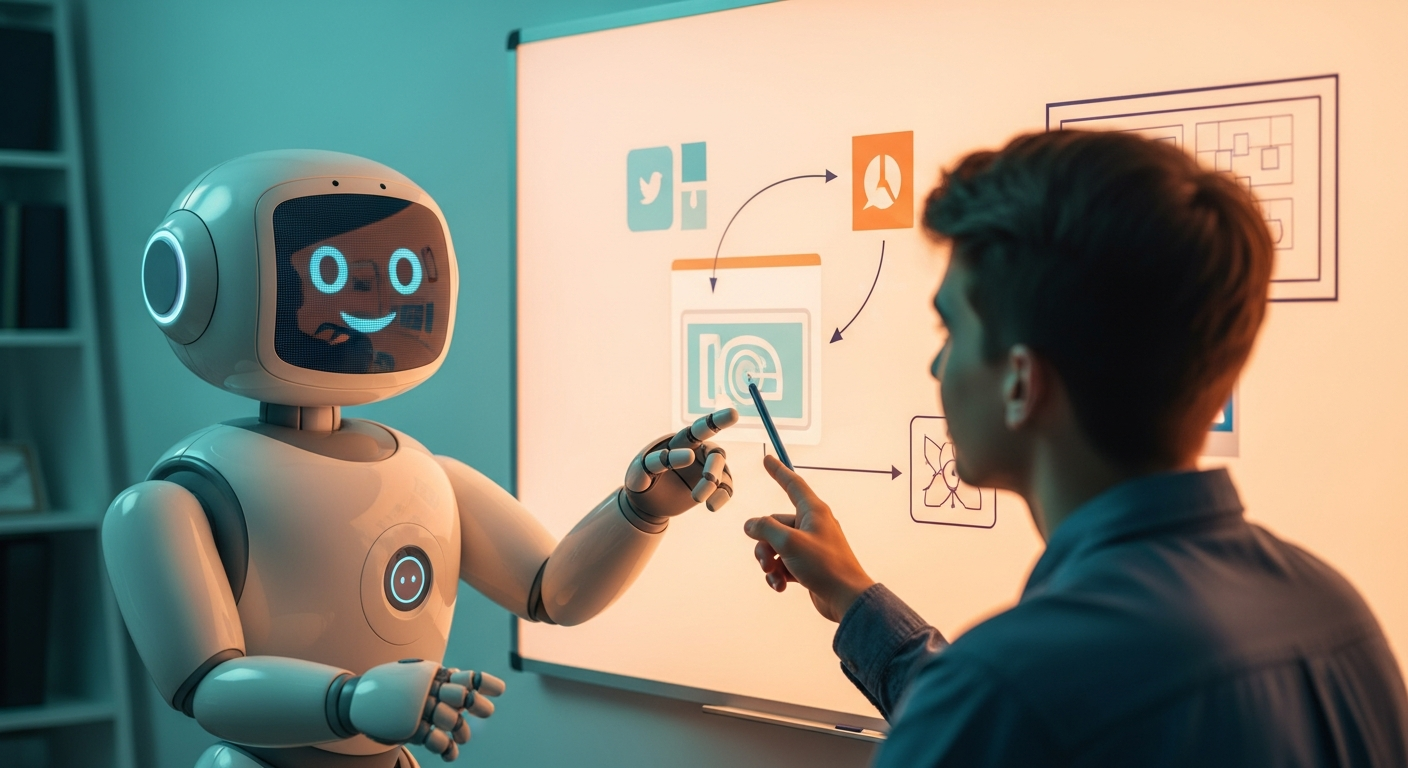
Remember the frustration of being stuck on a complex calculus derivative or a nuanced literary analysis at 11:00 PM with no one to turn to? For decades, the only solution was to wait for the next school day or pay for expensive private tutoring. However, the landscape of education is undergoing a seismic shift. We are moving away from static textbooks and toward a world of generative AI for education, where every student has a world-class mentor in their pocket.
The rise of the ai tutor for students is not just about convenience; it is about a fundamental change in how we process information. This isn't just a "bot" that spits out facts; it is a sophisticated ai study companion capable of understanding your unique struggles. As we navigate 2024, the goal is no longer just to find an app that gives you the answer, but to find a partner that helps you understand the "why" behind the "what."
Key Takeaway: The transition from traditional tutoring to AI-powered learning represents a shift from passive consumption to active, personalized engagement with knowledge.
#The Evolution of Study Tools: Why Every Student Needs an AI Study Companion in 2024
Just a few years ago, digital study tools were limited to digital flashcards and search engines. While helpful, these tools were "dumb"—they couldn't adapt to a student's pace or explain a concept in a different way if the first explanation didn't click. In 2024, AI learning tools 2024 have evolved into highly sophisticated systems that can simulate human-like reasoning and empathy, making them indispensable for modern academic success.
The modern curriculum is faster and more demanding than ever before. Students are expected to synthesize vast amounts of data across multiple disciplines. An ai study companion acts as a bridge, filling the gaps left by traditional classroom settings. It provides the 24/7 virtual tutoring necessary to keep up with rigorous schedules, ensuring that a single misunderstood concept doesn't snowball into a semester-long struggle. This is the new standard for academic agility.
Furthermore, the democratization of high-quality education is the most significant impact of this evolution. Previously, personalized attention was a luxury reserved for those who could afford private tutors. Today, AI-powered academic support levels the playing field, offering elite-level guidance to any student with a smartphone. This evolution isn't just a trend; it’s a necessary response to the complexities of modern learning.
Key Takeaway: In 2024, AI study companions are no longer optional "extras" but essential tools for navigating an increasingly complex and fast-paced educational environment.
#Key Features to Look for in the Best AI Tutor App: Beyond Simple Chat Interfaces
When searching for the best ai tutor app, many students make the mistake of choosing the first chatbot they find. However, a true educational tool requires more than just a text box. You should look for "multimodal" capabilities—the ability for the AI to "see" a photo of your handwritten math problem, "hear" your questions via voice, and "respond" with diagrams or interactive graphs. A simple chat interface is often just a search engine in disguise; a true tutor interacts with the material alongside you.
Another critical feature is "scaffolded learning." This means the AI doesn't just solve the problem for you. Instead, it breaks the problem down into manageable chunks. If you are struggling with a chemistry equation, the app should first ask if you understand the underlying periodic trends before jumping into the math. This ensures that you are building a foundation of knowledge rather than just completing a task.
Finally, look for adaptive learning platforms that offer progress tracking and memory. The best apps remember what you struggled with yesterday and circle back to reinforce those concepts today. They should provide a personalized dashboard that highlights your strengths and weaknesses, allowing you to focus your study sessions where they will have the most impact. Without these features, an AI tool is just a temporary fix, not a long-term learning partner.
Key Takeaway: The best AI tutor apps prioritize multimodal interaction, scaffolded learning, and long-term progress tracking over simple, one-off answers.
#Personalized AI Tutor vs. Generic Chatbots: Why Context and Curriculum Alignment are Crucial
There is a massive difference between a generic chatbot like standard ChatGPT and a personalized ai tutor designed specifically for education. Generic bots are trained on the entire internet, which includes plenty of misinformation and non-academic content. A dedicated AI tutor, however, is often "grounded" in verified educational datasets and aligned with specific curricula like AP, IB, or Common Core. This alignment ensures that the help you receive is relevant to what you will actually be tested on.
Context is everything in education. If you ask a generic bot about "the revolution," it might give you a history of the French Revolution when you are actually studying the Industrial Revolution. A personalized ai tutor allows you to upload your syllabus, your specific textbook chapters, and even your teacher's lecture notes. This creates a "context window" where the AI understands exactly where you are in your course, making its guidance infinitely more accurate and helpful.
Moreover, specialized tools are designed to avoid "hallucinations"—the tendency of AI to confidently state incorrect facts. Educational AI platforms often include cross-referencing features that check their logic against academic databases. This level of precision is what separates a toy from a professional academic tool. When your grades are on the line, you need a system that understands the specific nuances of your academic journey.
Key Takeaway: Curriculum alignment and contextual awareness are what transform a generic chatbot into a reliable, high-stakes academic mentor.
#How AI Homework Help is Moving Beyond Just Giving Answers to Teaching Concepts
The biggest criticism of ai homework help has traditionally been that it facilitates cheating. However, the industry is shifting toward a "Socratic Mentor" model. In this model, the AI is programmed to be "helpful but not too helpful." If a student asks for the answer to a math problem, the AI might respond, "I can help you solve that! First, let's look at the variables. What do you think the first step should be to isolate X?"
This pedagogical shift mimics the behavior of the world's best human teachers. By guiding the student through the logic of the problem, the AI helps build "muscle memory" for the subject matter. This approach transforms ai homework help from a shortcut into a deep-learning experience. The goal is for the student to eventually be able to solve the problem without the AI’s help, which is the ultimate definition of successful teaching.
Furthermore, these tools can now offer "analogous explanations." If you don't understand how a cell membrane works through a biological explanation, the AI can pivot and explain it using the analogy of a security guard at a concert. This ability to rephrase, reframe, and retry is something that traditional homework help—and even some busy teachers—simply cannot provide at scale. It turns every homework assignment into a private masterclass.
Key Takeaway: Modern AI tools act as Socratic Mentors, focusing on the process of discovery rather than the delivery of the final answer.
#Top AI Tutors for Students: A Comparative Review of Leading Platforms
Choosing the right ai tutor for students depends heavily on your specific needs. For those looking for a comprehensive, curriculum-aligned experience, platforms like Khanmigo (by Khan Academy) are leading the way. Khanmigo is specifically designed to be a Socratic tutor, integrated directly into the world-class Khan Academy video library. It’s excellent for K-12 students who need a safe, guided environment that won't just do the work for them.
For university-level students or those dealing with complex STEM subjects, tools like WolframAlpha combined with AI plugins offer unparalleled computational power. While Wolfram provides the raw mathematical "truth," the AI layer helps explain the steps in plain English. For language learners, Duolingo's Max tier uses generative AI to simulate real-world conversations and provide "Explain My Answer" features that clarify grammatical mistakes in real-time.
If you are a student focused on research and writing, Perplexity AI or Explainpaper are game-changers. These tools don't just summarize; they allow you to upload complex academic papers and "talk" to them, asking the AI to simplify the methodology or explain the results. Each of these platforms represents a different strength in the best ai tutor app market, proving that the "best" tool is the one that aligns with your specific academic hurdles.
Key Takeaway: From Khanmigo’s Socratic guidance to Wolfram’s computational depth, the right AI tool depends on whether you need curriculum support, STEM logic, or research assistance.
#The Ethics of AI in Education: Maintaining Academic Integrity while using AI tools
As we embrace AI-powered academic support, we must address the elephant in the room: academic integrity. Using AI to generate an entire essay and submitting it as your own is not learning; it is plagiarism. However, using AI to brainstorm an outline, explain a difficult concept you plan to write about, or check your grammar is a legitimate use of technology. The line is drawn at "authorship."
To maintain integrity, students should be transparent with their educators about how they use these tools. Many forward-thinking institutions are now encouraging "AI-augmented" assignments, where students submit their AI prompts alongside their final work to show their thought process. Using a personalized ai tutor should be seen as a way to enhance your brain's capabilities, not replace them. If you can’t explain the logic of your final answer, you haven't used the tool correctly.
Ethical use also involves critical thinking. AI can be wrong. A responsible student uses an ai study companion as a starting point, always verifying critical facts and cross-referencing with primary sources. By treating the AI as a "consultant" rather than an "oracle," students can harness the power of technology while remaining the masters of their own education.
Key Takeaway: Academic integrity in the age of AI is defined by using technology to facilitate understanding and brainstorming, rather than outsourcing the final output.
#Maximizing Your Learning: Practical Tips for Interacting with Your AI Tutor
To get the most out of your ai study companion, you need to learn the art of "educational prompting." Instead of asking "What is the answer?" try asking "Can you explain this concept to me like I'm a beginner?" or "I think the answer involves the Law of Diminishing Returns, but I'm not sure why. Can you walk me through it?" The more context you provide about what you *do* know, the better the AI can help you with what you *don't* know.
Another powerful tip is to use the "Reverse Tutor" method. Tell the AI: "I have been studying the causes of the Civil War. I want you to act as a professor and quiz me. Ask me one question at a time, wait for my answer, and then give me feedback on my logic." This flips the script and forces you into active recall, which is one of the most effective ways to move information into long-term memory.
Finally, utilize the multimodal features. If you are a visual learner, ask the AI to "create a table comparing mitosis and meiosis" or "describe a mental image I can use to remember the Krebs cycle." By tailoring the output to your specific learning style, you transform a generic interaction into a personalized ai tutor session that sticks.
Key Takeaway: Effective AI learning requires active prompting, such as asking for analogies, using the "Reverse Tutor" method, and requesting visual data structures.
#The Future of Education: How AI is Democratizing One-on-One Instruction
For decades, educational researchers have pointed to "Bloom's 2 Sigma Problem"—the finding that students tutored one-on-one perform two standard deviations better than those in a traditional classroom. The only problem was that one-on-one tutoring for every child was economically impossible. AI-powered academic support finally solves this problem. We are entering an era where the "2 Sigma" advantage is available to everyone, regardless of their zip code or income level.
The future of generative ai for education will see even deeper integration. Imagine an AI that doesn't just help with homework, but coordinates with your teacher to understand your specific learning gaps. It will be an "educational co-pilot" that stays with a student from elementary school through college, building a massive knowledge graph of everything they’ve learned and where they need more help. This is the ultimate promise of adaptive learning platforms.
As these tools become more refined, the role of the human teacher will also evolve. Instead of spending hours grading repetitive worksheets or lecturing on basic facts, teachers will become high-level mentors and emotional support systems for their students. The AI handles the "knowledge transfer," while the human teacher handles the "wisdom and inspiration." This synergy is the future of a truly educated society.
Key Takeaway: AI is the key to solving the "2 Sigma Problem," providing the benefits of elite one-on-one tutoring to the global masses for the first time in history.
#Conclusion: Embracing the Future of Personalized Learning
The journey from the "bot" to the "mentor" is well underway. Choosing the best ai tutor app is about more than just finding a quick fix for tonight's assignment; it is about selecting a partner that respects your intelligence and challenges you to think deeper. By focusing on personalized ai tutors that prioritize the Socratic method, curriculum alignment, and ethical engagement, you are setting yourself up for a lifetime of self-driven learning.
As we move further into 2024, don't be afraid to experiment with these AI learning tools. Use them to bridge your gaps, test your knowledge, and explore subjects that previously seemed too daunting. The power of a world-class education is now at your fingertips. The only question is: are you ready to stop asking for the answer and start asking for the "why"?
Ready to transform your study habits? Start by identifying one subject you’ve been struggling with and try the "Reverse Tutor" method with an AI companion today. Your journey to academic mastery starts with a single, better question.
Read next
See all →
Unlocking Personalized Learning in 2024: How AI is Transforming Education
Explore the transformative impact of AI on personalized learning in 2024. From adaptive platforms to AI companions, discover tools that enhance education.
Transforming Learning: How AI Math Animation Makes Complex Concepts Click in 2023
Explore the transformative power of AI math animation tools in education. These innovative resources help students grasp complex mathematical concepts through engaging visuals.
Transform Your Study Routine in 2024: The Ultimate Guide to PDF to Quiz Generators
Transform your study routine in 2024 by utilizing PDF to quiz generators. This guide covers various tools, tips, and benefits to enhance your learning.