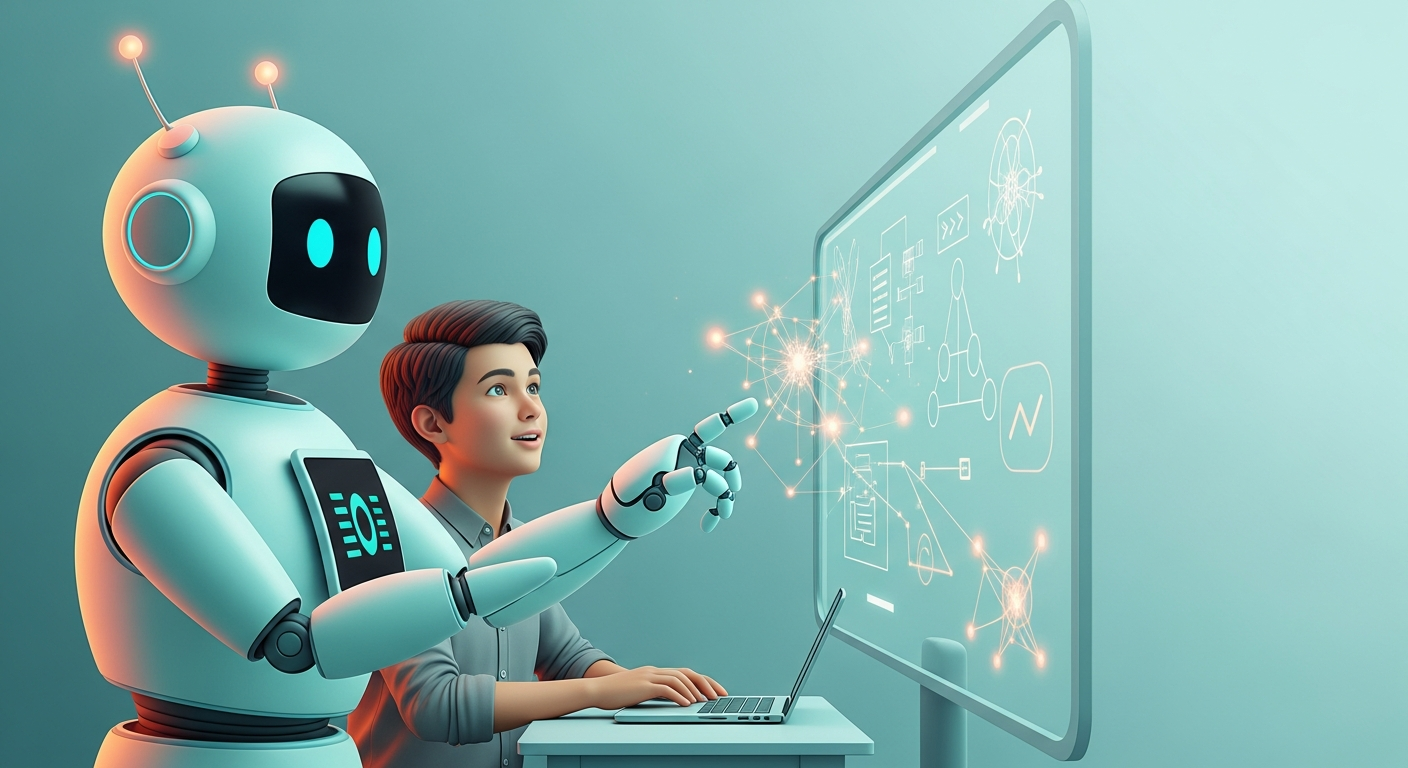
It’s 2:00 AM. The glow of a laptop screen is the only light in the room, and the calculus problem on the page looks less like math and more like an ancient, indecipherable script. For decades, this "study struggle" was a lonely rite of passage for students. You either had a parent who remembered high school trigonometry, a very expensive private tutor on speed dial, or you simply waited until the next day to ask a teacher—hoping you wouldn’t fall behind in the meantime.
Today, the landscape of educational technology for students has shifted dramatically. We are no longer limited by office hours or the availability of human experts. The rise of artificial intelligence has introduced a new player to the late-night study session: the ai study companion. However, as the market becomes flooded with generic chatbots, a critical question emerges: Is the app helping you learn, or is it just doing the work for you? To achieve true mastery, students need more than an answer engine; they need a sophisticated, personalized ai tutor that understands the nuances of pedagogy.
Key Takeaway: The best AI tools move beyond providing quick answers, serving instead as long-term partners in a student's cognitive development and academic journey.
#What Exactly is an AI Tutor? (More Than Just a Chatbot)
To the uninitiated, an ai tutor for students might seem like just another version of ChatGPT. While both are built on large language models, the difference lies in the "instructional layer." A standard chatbot is designed to be helpful and brief, often providing the final answer to a question immediately. In contrast, the best ai tutor app is programmed with educational frameworks. It doesn’t just tell you that the answer is "X"; it asks you how you might go about finding "X" yourself.
An authentic AI tutor acts as a bridge between raw information and conceptual understanding. It utilizes adaptive learning technology to assess a student’s current knowledge level and tailors its explanations accordingly. If a student struggles with a physics concept, the AI doesn't just repeat the textbook definition; it might pivot to a sports analogy or a visual breakdown to make the concept stick. This level of interaction transforms the tool from a static database into a dynamic, responsive mentor.
Key Takeaway: True AI tutoring is defined by pedagogical intent—using specialized software to guide a student through the process of discovery rather than simply delivering facts.
#The Shift from Passive to Active: How a Personalized AI Tutor Drives Mastery
Passive learning—reading a chapter or watching a lecture—is one of the least effective ways to retain information. Real mastery occurs through active recall and critical thinking. This is where the "Socratic Shift" comes into play. By employing Socratic AI learning techniques, high-quality apps prompt students to explain their reasoning. This method forces the brain to retrieve information, identify gaps in logic, and solidify connections between ideas.
When a student uses a personalized ai tutor, the experience is uniquely theirs. The AI tracks which topics the student masters quickly and which ones require more reinforcement. This creates a "Goldilocks" zone of learning—not too easy to cause boredom, and not too hard to cause frustration. By maintaining this balance, AI tutors help students enter a state of "flow," where deep learning happens naturally and efficiently.
Key Takeaway: By prioritizing active participation over passive consumption, AI tutors empower students to take ownership of their learning process and achieve deeper conceptual mastery.
#Key Features to Look for in the Best AI Tutor App
With hundreds of apps claiming to be the "best," how do you separate the revolutionary tools from the gimmicks? First, look for multi-modal capabilities. The best ai tutor app should allow students to upload photos of their handwritten notes, speak their questions aloud, or interact with diagrams. Learning isn't just text-based, and your tutor shouldn't be either. Integration with adaptive learning technology is also non-negotiable; the app must evolve as the student progresses.
Second, look for "Step-by-Step Scaffolding." A quality ai study companion will break down complex problems into manageable chunks. If you’re working on a chemistry equation, the app should guide you through balancing the atoms one by one, providing hints when you stumble. Finally, check for subject breadth. Whether you need AI for test prep for the SATs or help with a niche elective like Art History, the tool should have a robust knowledge base that spans the entire academic spectrum.
Key Takeaway: Look for multi-modal inputs, adaptive scaffolding, and a wide range of subject expertise when choosing an AI tutoring platform.
#AI Homework Help vs. Academic Integrity: Using AI as a Coach, Not a Crutch
The biggest concern for educators and parents regarding ai homework help is the potential for cheating. If an app simply solves a math problem or writes an essay, the student’s brain effectively "turns off," leading to a decline in skills over time. However, when used as a coach, AI can actually enhance academic integrity. By focusing on the *how* and *why* instead of the *what*, AI tutors ensure that the student is the one doing the heavy lifting.
For example, instead of writing a paragraph for a student, a high-quality ai tutor for students might say, "Your thesis statement is a bit broad. How could you make it more specific to the evidence you found in chapter three?" This approach maintains the student’s "voice" and ensures they are developing the necessary writing and critical thinking skills. It turns the AI into a collaborator that upholds the standards of the classroom while providing the 24/7 academic support students need to succeed.
Key Takeaway: To avoid the "crutch" trap, choose AI tools that use guided questioning and feedback rather than those that generate completed assignments.
#The Benefits of a 24/7 AI Study Companion for Neurodivergent Learners
For students with ADHD, dyslexia, or executive functioning challenges, the traditional classroom can sometimes feel overwhelming. A 24/7 academic support system provided by an AI can be a game-changer. AI tutors are infinitely patient; they never get frustrated if a student needs a concept explained ten different ways. This creates a "judgment-free zone" where students feel safe to admit they are confused—a psychological safety that is essential for learning.
Furthermore, an ai study companion can help with executive functioning by breaking down large projects into small, actionable steps. For a student who feels paralyzed by a 10-page research paper, the AI can help create a schedule, brainstorm an outline, and set mini-deadlines. This structure reduces anxiety and allows neurodivergent learners to showcase their true intelligence without being hindered by the "clutter" of organization.
Key Takeaway: AI tutors provide a low-pressure, highly structured environment that is particularly beneficial for students who require personalized pacing and organizational support.
#Top Use Cases: From Solving Complex Calculus to Brainstorming Essay Outlines
The versatility of modern AI is staggering. In the realm of STEM, ai homework help is most effective when it acts as a digital whiteboard. Students can walk through the steps of a calculus derivative, and the AI can pinpoint the exact moment a sign was flipped or a rule was misapplied. This immediate feedback loop prevents the "reinforcement of errors," which often happens when a student does an entire problem set incorrectly before realizing their mistake.
In the humanities, AI excels at the "blank page" stage. Using AI for test prep or essay writing doesn't mean letting the machine write the content. Instead, students can use the AI to brainstorm themes for a literature analysis or to quiz them on historical dates and their significance. By acting as a sophisticated sounding board, the AI helps students organize their thoughts and refine their arguments before they ever start typing their final draft.
Key Takeaway: Whether it's debugging code, balancing equations, or outlining an argumentative essay, AI tutors serve as a versatile "second brain" for any subject.
#The Human Element: Why AI Complements Rather Than Replaces Teachers
Despite the power of adaptive learning technology, AI is not a replacement for human teachers. Education is a deeply social and emotional process. A teacher provides inspiration, mentorship, and a nuanced understanding of a student's personal life that an algorithm cannot replicate. The goal of the best ai tutor app is to handle the "drills" and the foundational explanations, freeing up human teachers to focus on high-level discussions and emotional support.
Think of it like a world-class athlete. The athlete has a head coach (the teacher) who sets the strategy and provides inspiration, but they also have a gym and specialized equipment (the AI tutor) to practice their skills every single day. When students use a personalized ai tutor at home, they come to class better prepared, allowing the teacher to move past the basics and dive into more engaging, collaborative activities.
Key Takeaway: AI is a powerful tool that augments the educational experience, allowing teachers to focus on mentorship while the AI provides individualized practice.
#Privacy and Safety: What Students and Parents Need to Know
As with any educational technology for students, data privacy is paramount. When choosing an AI tutoring platform, it is essential to look for companies that are transparent about their data usage. Does the app sell student data to third parties? Is the information encrypted? Parents should look for tools that are COPPA (Children's Online Privacy Protection Act) and GDPR compliant to ensure that the student’s learning journey remains private and secure.
Beyond data privacy, "algorithmic safety" is also a concern. The best ai tutor app will have guardrails in place to ensure the AI doesn't provide inappropriate content or hallucinate incorrect facts. Reputable apps often use "grounded" AI, which means the model is forced to pull information from verified educational sources rather than the entire (and sometimes unreliable) internet. Checking reviews and the company’s "About" page for their safety protocols is a vital step for any parent or educator.
Key Takeaway: Prioritize AI platforms that demonstrate a commitment to data security and use verified educational datasets to ensure accuracy and safety.
#Conclusion: Embracing the New Standard of Personalized Education
The era of the "one-size-fits-all" education is coming to an end. With the advent of the personalized ai tutor, we are entering a period where every student can have access to high-quality, 24/7 academic support that adapts to their unique needs, strengths, and weaknesses. By shifting our perspective from "AI as a shortcut" to "AI as a Socratic partner," we unlock a level of cognitive empowerment that was previously reserved for those who could afford elite private tutoring.
Finding the best ai tutor app isn't just about finding the one with the most features; it's about finding the one that challenges you to think, supports you when you stumble, and celebrates your "Aha!" moments. As you navigate your academic journey, remember that the goal isn't just to get the grade—it's to master the material. With the right ai study companion by your side, true mastery is closer than ever before.
Ready to transform your study habits? Don't just settle for a chatbot. Look for a platform that prioritizes Socratic learning and adaptive technology. Start your journey toward academic excellence today by exploring the next generation of AI-powered educational tools!
Read next
See all →
Unlocking Personalized Learning in 2024: How AI is Transforming Education
Explore the transformative impact of AI on personalized learning in 2024. From adaptive platforms to AI companions, discover tools that enhance education.
Transforming Learning: How AI Math Animation Makes Complex Concepts Click in 2023
Explore the transformative power of AI math animation tools in education. These innovative resources help students grasp complex mathematical concepts through engaging visuals.
Transform Your Study Routine in 2024: The Ultimate Guide to PDF to Quiz Generators
Transform your study routine in 2024 by utilizing PDF to quiz generators. This guide covers various tools, tips, and benefits to enhance your learning.