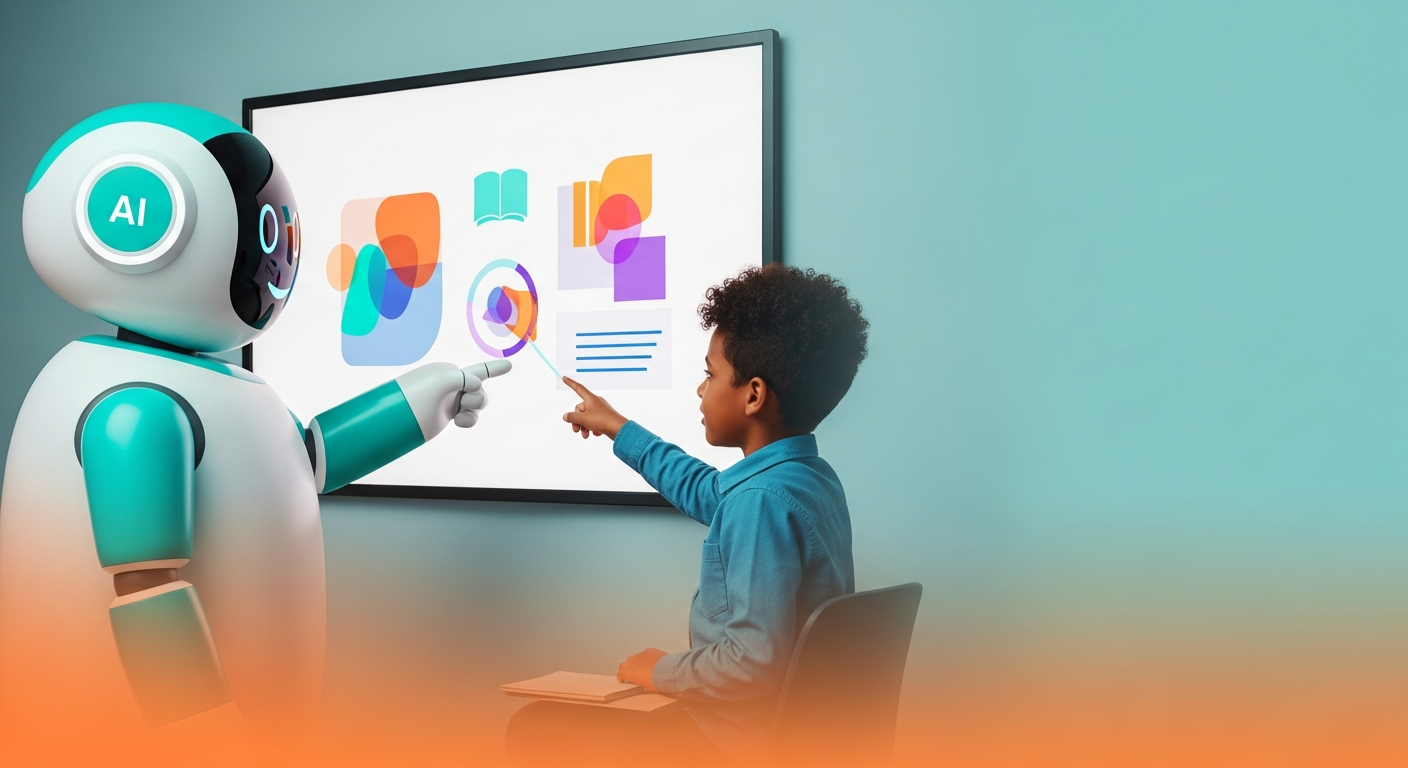
#Introduction: The Evolution of Learning—From Search Engines to AI Study Companions
Remember the days when "researching" meant spending hours scrolling through blue links on a search engine, hoping to find a forum post that explained a complex calculus theorem? For decades, the internet was a library—a vast, static repository of information. But in 2024, the library has started talking back. We have moved from the era of search into the era of the ai tutor for students, a shift that is fundamentally changing how knowledge is acquired and mastered.
The rise of generative AI for education has sparked a massive debate in classrooms around the world. While some see it as a threat to academic integrity, the reality is far more nuanced. We are witnessing the birth of the virtual learning assistant—a tool that doesn't just provide answers, but facilitates understanding. The goal is no longer just to find the information, but to engage with it in a dialogue that mirrors the experience of sitting down with a world-class private tutor.
This article isn't about how to use AI to skip your homework. Instead, we are exploring how to leverage a personalized AI tutor to bridge the gap between passive consumption and active mastery. By the end of this guide, you will understand how to select an AI study companion that acts as a Socratic mentor, pushing you to think harder rather than giving you an easy way out.
Key Takeaway: The transition from search engines to AI tutors marks a move from "finding information" to "engaging in dialogue," transforming the student from a passive reader into an active learner.
#What Exactly is a Personalized AI Tutor? (And Why It’s Not Just ChatGPT)
To the uninitiated, an ai tutor for students might seem identical to a standard chatbot like ChatGPT or Claude. However, there is a critical distinction between a general-purpose Large Language Model (LLM) and a purpose-built personalized AI tutor. While a general chatbot is designed to be helpful and provide immediate answers, a dedicated AI tutor is programmed with pedagogical principles. It understands that the goal of education is the struggle of learning, not the speed of completion.
A true AI study companion is built on adaptive learning platforms. These systems track a student's progress, identify specific knowledge gaps, and adjust the difficulty level of the material in real-time. If you are struggling with quadratic equations, a specialized AI tutor won't just solve the problem for you. Instead, it might ask, "What do you think the first step is to isolate the variable?" It guides the student through the cognitive process, ensuring that the underlying concepts are cemented before moving on to the next topic.
Furthermore, these tools are often "wrapped" in safety and educational frameworks. They are designed to prevent hallucinations (making things up) and are often grounded in specific textbooks or curricula. This makes them far more reliable for 24/7 study support than a generic chatbot that might inadvertently provide incorrect historical dates or flawed mathematical logic. When you choose the best AI tutor app, you aren't just getting an AI; you're getting a digital mentor that knows when to help and when to let you struggle.
Key Takeaway: Unlike general chatbots, a personalized AI tutor uses pedagogical "guardrails" to prioritize long-term understanding over instant answers.
#The Core Benefits: Why Every Student Needs an AI Tutor for Students
The most significant of the AI-powered tutoring benefits is the democratization of one-on-one instruction. Historically, private tutoring was a luxury reserved for those who could afford high hourly rates. An ai tutor for students provides that same level of personalized attention at a fraction of the cost, or even for free. This allows students to receive 24/7 study support, meaning they can get help at 11:00 PM on a Sunday night when a human tutor is unavailable.
Another major benefit is the reduction of "learning anxiety." Many students feel intimidated to ask "dumb" questions in a crowded classroom or even in front of a human tutor. An AI is infinitely patient and non-judgmental. A student can ask the same question ten different ways until the concept finally clicks. This creates a safe "sandbox" for intellectual curiosity, where the fear of being wrong is replaced by the excitement of discovery. This psychological safety is a cornerstone of adaptive learning platforms.
Finally, AI tutors excel at "micro-personalization." In a standard classroom, a teacher must teach to the "middle" of the class, often leaving behind those who are struggling and boring those who are ahead. A virtual learning assistant can pivot instantly. If a student is a visual learner, the AI can generate diagrams or use metaphors related to the student's specific interests, such as explaining physics through the lens of skateboarding or music production. This level of customization makes the learning process significantly more engaging and effective.
Key Takeaway: AI tutors democratize high-quality education by providing non-judgmental, highly personalized, and affordable 24/7 support for every type of learner.
#How to Identify the Best AI Tutor App: 5 Features to Look For
With dozens of new tools hitting the market every month, finding the best AI tutor app can be overwhelming. To ensure you are choosing a tool that fosters genuine growth, you should look for these five essential features:
- Socratic Questioning: The app should respond to your questions with leading questions of its own. If you ask "How do I solve this?", the AI should respond with "Let's look at the first part of the formula—what does this symbol represent to you?"
- Multi-Modal Capabilities: Learning isn't just text. The best tools allow you to upload photos of your handwritten notes, listen to voice explanations, or even generate interactive graphs and charts.
- Progress Tracking and Analytics: A high-quality ai study companion should provide a dashboard showing your mastery levels across different topics. It should know that you've mastered "Cell Biology" but still need work on "Mitosis."
- Integration with Trusted Sources: Look for platforms that cite their sources or are built on top of verified educational databases (like Khan Academy's Khanmigo) rather than just the open internet.
- Memory and Context: The AI should remember your previous sessions. It should be able to say, "Remember how we talked about the French Revolution yesterday? Today's topic on the Industrial Revolution actually shares some similar causes."
Choosing a tool based on these criteria ensures that you are investing your time in a platform that builds skills rather than one that simply automates tasks. The goal is to find a virtual learning assistant that challenges you to be a better student, not one that replaces the need for you to study in the first place.
Key Takeaway: The best AI tutor apps prioritize Socratic questioning, multi-modal interaction, and long-term progress tracking over simple answer generation.
#Moving Beyond AI Homework Help: Using AI to Build Critical Thinking
The term ai homework help often carries a negative connotation, suggesting a shortcut to a finished assignment. However, when used correctly, AI can be the ultimate tool for developing critical thinking. Instead of asking the AI to "write this essay," a student can use it to "stress-test my argument." By feeding the AI a thesis statement and asking it to play devil's advocate, the student is forced to anticipate counterarguments and strengthen their reasoning.
This shift from "answer-seeking" to "thought-partnering" is where the real magic happens. A student can use an ai tutor for students to engage in "active recall" sessions. They can say, "I have just finished reading a chapter on photosynthesis. Quiz me on the most difficult concepts and don't let me move on until I've explained the Calvin cycle in my own words." This transforms the AI from a vending machine of information into a rigorous personal trainer for the mind.
Furthermore, AI can help students bridge the gap between abstract theory and real-world application. If a student is struggling to see the point of learning calculus, they can ask their personalized AI tutor to "show me how this specific derivative formula is used in the field of aerospace engineering." By providing context and purpose, the AI helps the student move beyond rote memorization and toward a deeper, more meaningful understanding of the subject matter.
Key Takeaway: Shift your perspective: use AI as a "thought partner" to challenge your arguments and quiz your knowledge, rather than a tool to complete your tasks.
#Real-World Use Cases: How an AI Study Companion Transforms Different Subjects
The versatility of an AI study companion makes it valuable across the entire academic spectrum. In the humanities, for example, a student can use generative AI to "interview" a historical figure. By prompting the AI to stay in character as Abraham Lincoln or Marie Curie, the student can explore historical perspectives through a simulated conversation, making the past feel vibrant and immediate.
In STEM subjects, the best AI tutor app acts as a real-time troubleshooter. For a computer science student, the AI can review code not just to find bugs, but to explain why a specific logic error occurred and suggest more efficient algorithms. For a chemistry student, the AI can simulate molecular structures and explain the bond angles in a way that a 2D textbook image never could. This 24/7 study support ensures that a student never gets "stuck" on a single problem for hours.
Language learning is another area where generative AI for education shines. Traditional apps often rely on repetitive flashcards. An AI tutor, however, can engage in a full-blown conversation in the target language, correcting grammar and pronunciation in real-time while adapting the vocabulary to the student's current level. It provides the immersion of a study-abroad program from the comfort of a smartphone.
Key Takeaway: Whether it's role-playing with historical figures, debugging code, or practicing a new language, AI tutors provide immersive, subject-specific mastery that goes beyond traditional methods.
#Privacy and Ethics: How to Use AI Tutors Responsibly
As we integrate virtual learning assistants into our daily routines, we must address the "elephant in the room": privacy and ethics. When using an ai tutor for students, it is vital to understand how your data is being used. Students should look for platforms that are transparent about data encryption and ensure that their personal learning data isn't being sold to third-party advertisers. Always check if the tool is COPPA or GDPR compliant, especially for younger learners.
Ethically, the responsibility lies with the student to maintain academic integrity. Using ai homework help to generate an entire essay and submitting it as your own is not just cheating; it’s a missed opportunity to develop your own voice and cognitive abilities. The ethical way to use AI is as a "scaffolding" tool—something that supports you while you build the structure, but is eventually removed once the structure is sound. If you can't explain the answer the AI helped you reach, you haven't actually learned it.
Finally, it’s important to maintain a balance between human and AI interaction. While AI-powered tutoring benefits are vast, AI lacks the emotional intelligence and lived experience of a human teacher. Use AI to handle the technical drills, the 2:00 AM questions, and the data-driven practice, but continue to seek out human mentors for inspiration, nuance, and ethical guidance. The future of education isn't AI instead of humans; it's AI augmenting humans.
Key Takeaway: Responsible AI use requires a commitment to data privacy, academic honesty, and a healthy balance between digital tools and human mentorship.
#Conclusion: The Future of Education is Personalized
The journey from a simple chatbot to a sophisticated personalized AI tutor represents a new frontier in human potential. We are no longer limited by the size of a classroom or the availability of a teacher. With the right AI study companion, every student has the opportunity to experience the Socratic method, receiving a tailormade education that adapts to their unique pace, interests, and challenges.
Choosing the best AI tutor app in 2024 means looking for a tool that values your intellectual growth over your convenience. It means choosing a mentor that asks "Why?" as often as it provides an "How." As we move forward, the students who thrive will be those who view AI not as a shortcut to a grade, but as a catalyst for deeper curiosity and a partner in the pursuit of mastery.
Ready to transform your study habits? Don't just settle for a chatbot that gives you the answers. Start exploring adaptive learning platforms today and find an AI tutor that challenges you to think bigger. The future of your education is in your hands—and your prompts. Embrace the power of the Socratic AI and take the first step toward true subject mastery!
Read next
See all →
Unlocking Personalized Learning in 2024: How AI is Transforming Education
Explore the transformative impact of AI on personalized learning in 2024. From adaptive platforms to AI companions, discover tools that enhance education.
Transforming Learning: How AI Math Animation Makes Complex Concepts Click in 2023
Explore the transformative power of AI math animation tools in education. These innovative resources help students grasp complex mathematical concepts through engaging visuals.
Transform Your Study Routine in 2024: The Ultimate Guide to PDF to Quiz Generators
Transform your study routine in 2024 by utilizing PDF to quiz generators. This guide covers various tools, tips, and benefits to enhance your learning.